Most manufacturers we speak to have already decided they need to automate. What they don’t know is where to begin.
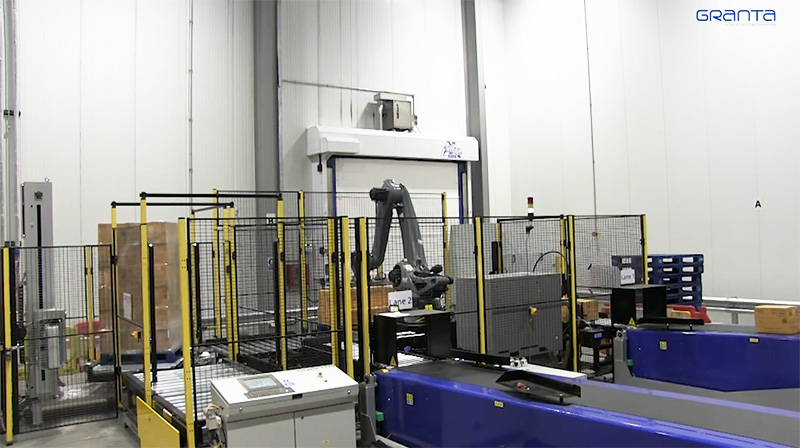
The answer is usually the end of the line. Not because palletising is glamorous, but because it is the one place where a first project is low-risk, easy to measure, and almost always solving a problem that already exists.
Where UK manufacturing actually stands
The gap is real. According to the International Federation of Robotics, Western European manufacturers reached a record 267 robots per 10,000 employees in 2024. In the UK, industrial robot installations fell 35% to 2,500 units in the same year, placing the country 19th worldwide.
Meanwhile the pressures haven’t gone anywhere. Labour is harder to find and more expensive. Manual handling claims are expensive and avoidable. Customers want shorter runs and more variety, which makes changeovers the enemy.
Automation is the obvious answer. The question is which project to do first.
Why the end of the line is the right first project
It is the heaviest manual work you have. Palletising handles the product at its final weight, after everything upstream has handled it light — and every unit the line makes passes through that one point. Repeated lifting is where the injuries, the absence and the claims sit, and it is also the hardest job on site to recruit for and keep staffed. Under the Manual Handling Operations Regulations 1992, hazardous manual handling has to be avoided where reasonably practicable, and an affordable engineering control now exists for this one. We’ve set out the hazards, the duties and the options in a separate article: Manual Handling Risks in Palletising.
It is self-contained. A palletiser sits at the end. It doesn’t require you to rebuild your process, change your recipes or retrain the whole factory. If you were going to try automation somewhere, this is the least disruptive place to try it.
It is easy to measure. Cases per hour, pallets per shift, downtime, stack quality. The numbers are obvious before and after, which makes the second project far easier to get approved.
It gives you data you didn’t have. A modern palletising cell logs production and downtime and reports on it. For a lot of sites, that end-of-line log is the first honest picture they’ve had of where the line actually stops.
What “smart factory” really means here
The Industry 4.0 language — connected plant, live data, systems talking to each other — is not wrong. It is just usually sold backwards, as a platform to buy before there’s anything to connect.
In practice it starts with one machine that produces reliable data. A palletising cell can log throughput and downtime, generate OEE reports, and connect to stock or data systems where that is useful. The fault logger shows where the bottlenecks really are. That is a far more useful first step than a dashboard with nothing behind it.
Three things to get right, so the first project isn’t the last
Plenty of manufacturers have automated once, had a poor experience, and stopped. It is nearly always one of these three.
1. Who can programme it
This is the one that quietly decides whether the system gets used properly. If every new product size needs a robot programmer, the machine becomes a constraint rather than a benefit.
On a Granta system, an operator enters four numbers — length, width, height and weight. The software generates the stack patterns and the work behind them: robot paths, clearances, safety zones, speed profiles, and the turning and grouping of product on the conveyors, including for row gripping. Switching between products already on the system takes seconds. A brand-new size takes about five minutes. Operator-level programming combined with automated row gripping is patented to Granta.
2. Whether it survives a change of plan
Your factory in five years will not be your factory today. Lines move, products change, volumes grow.
Most palletising cells are built bespoke and fixed. We offer a modular system— a standardised platform that comes up on four floor bolts and can be rearranged, extended or relocated. The point is not that it’s modular. The point is that the capital you spend now survives a change of mind later.
3. Whether it fits the space you actually have
Space is the reason many good projects stall. Low ceilings, mezzanines, pedestrian zones, food areas and sites going forklift-free all rule out a conventional cell.
Our compact palletiser takes the finished pallet off at floor level with a pallet truck, and still feeds empty pallets automatically at speed — a combination rarely available elsewhere.
The natural second step: moving the pallet
Once the pallet is built, something has to move it. On most sites that is a forklift making the same short journey dozens of times a day.
AMRs and AGVs take that journey over — from palletiser to wrapper, wrapper to dispatch — and pair with any palletising cell. It is the obvious next project once the first one has proved itself, and it is where forklift-free sites end up.
What a first project actually costs
Our standardised prebuilt palletiser is priced from £57,900 + VAT. Other systems are quoted to your line. Leasing is included with every quote, with savings that usually exceed the payments from the start, and payback across our installs is often under a year once labour, throughput and manual-handling costs are counted.
We’ll give you the numbers for your own line rather than an industry average.
Start with a look at your line
We will visit your site free of charge and produce a 3D CAD layout of a system in your own space, so you can see exactly what it would look like before you commit to anything.
Contact us on 01223 499488 or book a free site visit.
Watch automation videos…
Find out more…
- The Granta Cobot Palletiser: How It Is Specified, and Why We Believe It Leads the Market
- Automated Container Unloading: Why It Stayed Manual, and What Changed
- Manual Handling Risks in Palletising: Hazards, HSE Duties and Control Measures
- Case Study: Automating the Palletising of Insulation Batts with the Granta Cobot Palletiser
- Why “Ease of Use” Is the Most Important Metric in Robotic Palletising
 Bag Palletiser
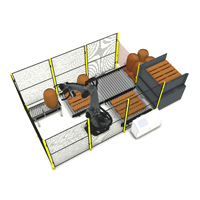 Barrel Palletiser
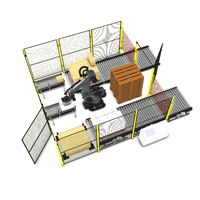 Box Palletiser
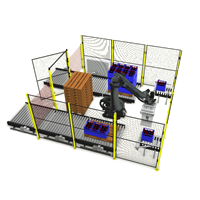 Crate Palletiser
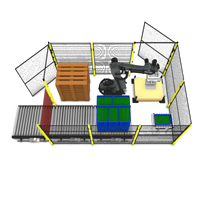 Tray Palletiser