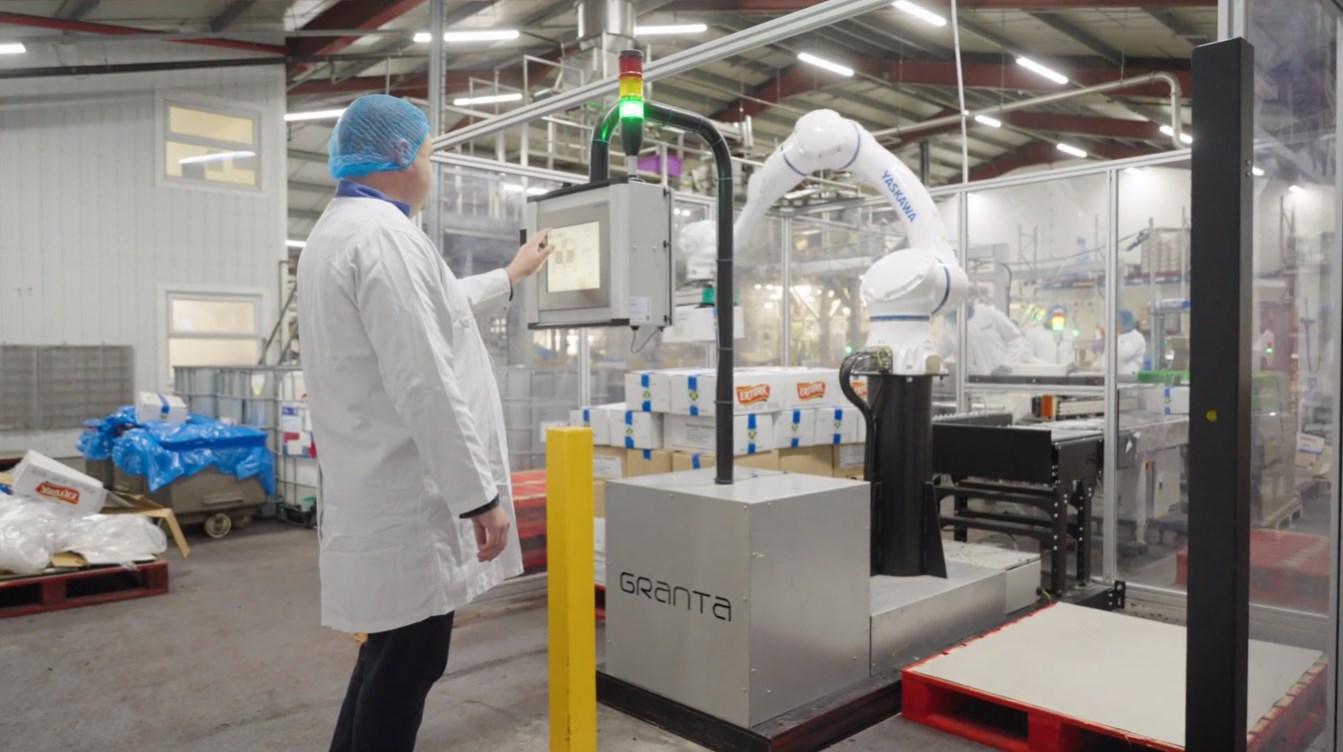
A cobot palletiser uses a collaborative robot rather than a conventional industrial one. The distinction is that a collaborative robot has force sensing built in, which allows it to work in a shared space with people under an appropriate safety assessment.
Cobot palletisers are now widely available, and the specifications look broadly similar on paper. In practice they differ in five areas that determine whether the system performs on a real production line: payload, duty rating, how safety is configured, how the system is programmed, and what it costs.
This article sets out how the Granta cobot palletiser is specified in each of those areas, and why we consider it the strongest cobot palletising system available.
1. Payload: 30 kg
The Granta cobot palletiser uses a 30 kg payload collaborative robot. This is at the upper end of the collaborative robot class.
Payload is not simply case weight. The gripper, its mounting and any vacuum or pneumatic assembly all count against the figure, and on a palletising cell the gripper is a significant proportion of it. A cobot rated at 10 or 16 kg has considerably less capacity available for product than the headline number suggests.
A 30 kg rating means realistic case weights can be handled with a substantial gripper fitted, and multi-pick remains possible. It also means the robot is not operating continuously at the limit of its rating, which affects service life.
2. Duty: industrial grade, specified for continuous running
Many collaborative robots are lightweight units originally designed for assembly and machine tending, where the duty cycle is intermittent. Palletising is not intermittent. The same motion is repeated for the length of every shift, indefinitely and typically with higher payloads.
The robot used in the Granta cobot palletiser is an industrial-grade collaborative robot specified for 24/7 operation. It is built for the duty cycle palletising actually imposes, rather than adapted to it.
It also uses dedicated force sensing. This is worth distinguishing from the approach used by many lightweight cobots, which infer contact from motor current or torque. Dedicated sensing detects unexpected force directly and stops the robot, which is held until the safety is reset.
3. Safety: three configurations, and speed retained
The most common misconception about cobot palletisers is that a collaborative robot means no guarding, and that this is the whole benefit. In practice, running permanently in collaborative mode means running permanently at collaborative speed, which safety standards limit to around 2-3 pick and place cycles per minute due to the maximum movement speed allowed.
The Granta cobot palletiser is offered in three configurations, and the choice is made against the layout of the floor rather than a default:
| Configuration | How it operates | Best suited to |
| No guarding, light curtains or scanners | Runs in collaborative mode at all times, at collaborative speed | Lower-speed applications where the smallest possible footprint matters |
| Guarding with a light curtain at the entry point | Runs at full industrial speed. Slows to collaborative speed when the light curtain is broken, and continues running | Higher-speed applications where an operator enters mainly for pallet changeover |
| Safety area scanners around the cell | Runs at full industrial speed. Slows to collaborative speed when the scanners detect movement in the safety zone, and continues running | Cells with frequent or unpredictable pedestrian movement nearby |
The point of the second and third configurations is that the system does not stop when someone approaches. It changes speed and keeps running, then returns to full speed once the zone is confirmed clear. Throughput is preserved during pallet changes and routine floor movement, which is where a stop-and-reset arrangement loses most of its output.
Many cobot palletisers are supplied in a single mode. Being able to select between all three, and to combine full-speed industrial running with collaborative operation when someone is present, is the practical difference in a working environment.
4. Programming: four dimensions, no robot programmer
Cobots are generally described as easy to programme, and by comparison with conventional robots they are. The comparison that matters, however, is against how a palletiser actually needs to be set up.
Most systems provide a drag-and-drop layer editor. The operator places each product on screen to build a layer, then rotates and duplicates it. The operator supplies the pattern; the software records it. The robot paths, clearances, safety zones, speed profiles and the orientation and grouping of product on the infeed are configured separately, and all of them change when the product size changes.
Granta’s software works in the opposite direction. The operator enters four dimensions — length, width, height and weight — and the software generates the viable stack patterns, ranks them by pallet efficiency, and derives everything downstream of the pattern, including the conveyor orientation and grouping required for row gripping. A new product size takes approximately five minutes and requires no robot-programming skill. Switching between sizes already held on the system takes seconds.
The same software is fitted to every Granta palletiser, so a cobot system is not a reduced-capability version of the range. The detail of how it differs from a pattern wizard is set out in Easy Palletiser Programming.
5. Cost: a premium specification without a premium price
A higher specification usually carries a higher price. In this case it does not, and the reason is production method rather than discounting.
Granta does not build cobot palletisers individually to order. They are built in batches, to a standardised design, and robots are purchased in batches of 25. Design time is spread across a production run instead of being charged to a single project, component costs fall with volume, and each system is assembled and tested to an established procedure rather than engineered from the beginning.
Volume is what makes that possible. Granta has one of the largest palletiser install bases in the UK and Ireland, and is among the largest installers of cobot palletisers in the country.
The result is that the Granta cobot palletiser is among the more competitively priced cobot palletising systems available, while using a 30 kg industrial-grade collaborative robot, three safety configurations and patented programming software. Leasing and hire options are included with every quote, and payback across our installations is frequently under a year once labour, throughput and manual handling costs are accounted for.
We will provide the figures for your own line rather than an industry average.
Specification summary
- 30 kg payload collaborative robot
- Industrial grade, specified for 24/7 operation, with dedicated force sensing
- Three safety configurations: unguarded, guarded with light curtain, or area scanner
- Throughput of 20+ products per minute, with row gripping available
- Single or double infeed, with conveyors orientated to suit the layout
- Single or double pallet positions, with pallet-truck take-off available
- Gripper options including vacuum, paddle and vacuum bag grippers
- Handles boxes, cases, packs, bags and sacks
- Patented easy programming software as standard
- Full CE and UKCA marking, with a technical file prepared for every project
- Typical lead time of two to four months but can be a lot faster if required
- Built in batches to a standardised design, which keeps the price competitive
Where a cobot is the right choice — and where it is not
A cobot palletiser is the appropriate specification where people need to work close to the cell, where floor space is restricted, or where full guarding would obstruct access. It is also a straightforward first automation project, because it integrates into an existing line with minimal disruption.
It is not the right answer to every application. Where throughput requirements are higher, or where open trays or heavier cases are handled, a compact or modular system using a 140 kg industrial robot is usually the better specification. We will say so during a site assessment rather than fit a cobot to an application that does not suit one.
Assessment on your own line
Granta designs, builds, programmes and supports its palletising systems in the UK, as a KUKA Platinum System Partner and a Yaskawa partner, with record UK sales achieved for both. The software is developed in-house.
We will visit your site free of charge and produce a 3D CAD layout of a cobot cell in your own space, including the safety zones, before any commitment is made.
Contact us on 01223 499488 or book a free site visit.
Watch automation videos…
Find out more…
- Is Your Warehouse Slowing Down? How to Spot Hidden Bottlenecks in Packing and Shipping
- The Granta Advantage: KUKA Platinum Status + Patented Software = Smarter Automated Palletising
- Why Granta Palletisers are the Preferred Choice for Contract Packers
- 5 Ways Automation Can Solve the UK’s Manufacturing Labour Shortage
- The Compact Palletiser: Big Performance in a Small Footprint
 Bag Palletiser
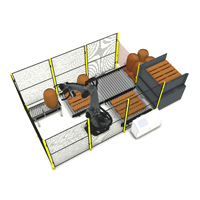 Barrel Palletiser
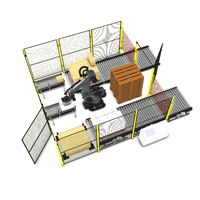 Box Palletiser
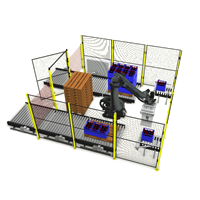 Crate Palletiser
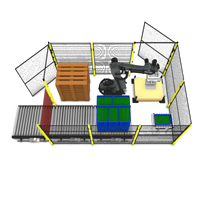 Tray Palletiser