Ask a health and safety manager where the risk sits in a factory and end of line comes up almost every time.
It is the same task, repeated: lift a case off a conveyor, twist, place it on a pallet. Then again, several hundred times a shift. Nothing dramatic ever happens. The damage is cumulative, which is exactly why it is so easy to leave alone.
That position is getting harder to hold.
The hazard: why end of line carries the heaviest handling
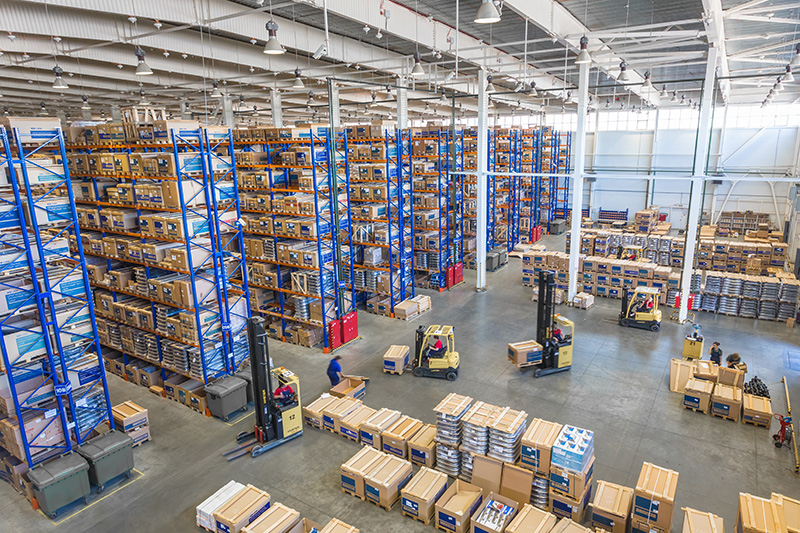
Palletising is usually the heaviest repetitive manual task on a production line, and that is a function of where it sits rather than how it is organised.
Everything upstream is handled in its lighter state — individual products, empty cartons, part-filled packs, components. By the end of the line the product is finished: filled, sealed, cased and at its final weight. It is also the point where the whole line converges, so every unit the process makes passes through the same pair of hands.
Highest weight and highest volume, in the same place. That is why end of line still carries the manual handling risk on sites that are well automated everywhere else.
The task itself is a repeated lift-twist-place cycle, typically several hundred times a shift. The recognised risk factors are all present: repetition, forceful exertion, trunk rotation, reaching at height as the pallet builds, and little variation in the movement. Injury is cumulative rather than acute, which is why the risk is often carried for years without a recorded incident.
What the HSE figures show
The Health and Safety Executive’s figures for 2024/25 make the scale clear. An estimated 511,000 workers in Great Britain were suffering from a work-related musculoskeletal disorder, including 173,000 new cases. Those conditions accounted for 7.1 million lost working days — an average of 14 days for every affected worker.
Backs are the biggest single category, at 43% of cases, with upper limbs and neck close behind at 41%.
HSE puts the total cost of workplace injuries and new cases of ill health at £22.9 billion a year.
Progress has stalled. Self-reported musculoskeletal disorders were trending downwards before the pandemic. They have now settled back at broadly pre-pandemic levels rather than continuing to fall.
Employer duties: the Manual Handling Operations Regulations 1992
The Manual Handling Operations Regulations 1992 set a clear order of priority. Avoid hazardous manual handling so far as is reasonably practicable. Where it cannot be avoided, assess it. Then reduce the risk.
Avoidance comes first. And what counts as “reasonably practicable” depends on what is realistically available at the time.
Twenty years ago, a palletising robot was a major capital project that a mid-sized manufacturer could reasonably say was out of proportion to the risk. That argument has weakened. Standardised systems are now openly priced — our prebuilt palletiser starts at £57,900 + VAT — leasing is available, and payback is often inside a year.
When an affordable, proven engineering control exists for a task that is causing injuries across the industry, the case for continuing to do it by hand becomes harder to write down. It is worth asking how your own risk assessment reads on that point today, rather than when it was last reviewed.
Workforce and staffing factors
The health and safety argument used to run into a practical objection: we’ll just staff it.
That is no longer straightforward.
Fewer people want repetitive manual lifting work, and those who do have other options. Sites report constant churn on end-of-line roles, agency cover at premium rates, and vacancies that stay open. An ageing workforce makes heavy repetitive tasks less viable over a full career, and each new starter needs training and supervision before they are productive.
There is also the hidden cost of variability. Hand-stacking slows as a shift wears on. Pallets built at the end of a long day are less consistent, which shows up later as transit damage and rejected loads.
Absence compounds all of it. One person off with a back injury on a two-person stacking role usually means the line either slows down or someone works harder to cover, which is how the next injury starts.
Engineering controls at end of line
A palletising cell takes the lifting out of the job entirely. The operator’s role becomes supervising the line, changing over products and dealing with exceptions — work that people are happy to do and that keeps them on site.
Three points are worth knowing when you’re assessing the options:
People working alongside the system. A cobot palletiser can work in a shared space with the right safety assessment, using guarding, light curtains or area scanners depending on the layout. There is more than one way to make it safe, and the right one depends on your floor.
Forklifts and pedestrians. A lot of sites are trying to reduce forklift movements in occupied areas, or remove them altogether from food production and pedestrian zones. Our compact palletiser is built for that. The finished pallet comes off at floor level and is taken away with a pallet truck, while empty pallets are still fed automatically at speed — a combination rarely available elsewhere, and one we have patent applied for.
The journey after the pallet is built. Once a pallet is wrapped, something moves it. AMRs and AGVs take over the repeated short runs between palletiser, wrapper and dispatch, which is usually where the remaining forklift traffic sits.
Assessing the case
Health and safety arguments often stall because they are presented on their own. They land better alongside the operational ones, because the same change fixes several problems at once:
- Lifting and twisting removed from the task
- Lost days and claims exposure reduced
- End-of-line roles that are easier to recruit for and keep
- Consistent pallet quality across a full shift, and less transit damage
- Throughput that holds steady rather than tailing off
We provide payback, ROI, OEE and intangible-benefits calculators, and will work through the figures for your own line so the case can be put to your board with real numbers rather than industry averages.
Where to start
If you want to see what it would look like on your floor, we will visit your site free of charge and produce a 3D CAD layout of a system in your own space — including how the pallet gets taken away and who stands where.
Granta designs, builds, programmes and supports palletising systems in the UK, as a KUKA Platinum System Partner and a Yaskawa partner, with record UK sales achieved for both.
Call 01223 499488 or book a free site visit.
Sources: HSE, Health and Safety at Work: Summary Statistics for Great Britain 2025 (2024/25 data); HSE, Manual Handling Operations Regulations 1992.
Watch automation videos…
Find out more…
- Is Your Warehouse Slowing Down? How to Spot Hidden Bottlenecks in Packing and Shipping
- The Granta Advantage: KUKA Platinum Status + Patented Software = Smarter Automated Palletising
- Why Granta Palletisers are the Preferred Choice for Contract Packers
- 5 Ways Automation Can Solve the UK’s Manufacturing Labour Shortage
- The Compact Palletiser: Big Performance in a Small Footprint
 Bag Palletiser
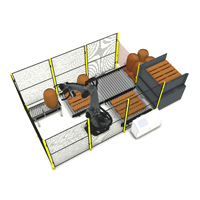 Barrel Palletiser
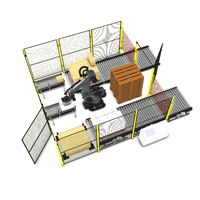 Box Palletiser
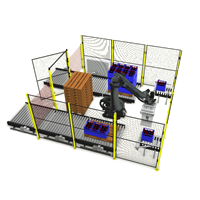 Crate Palletiser
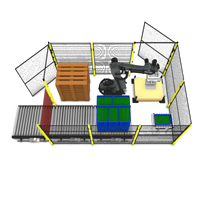 Tray Palletiser