
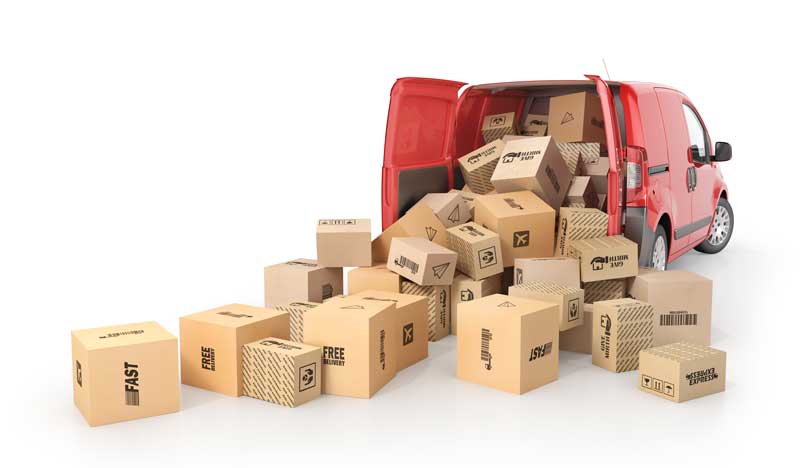
Damaged deliveries are usually treated as a transport problem. The vehicle braked hard, the load shifted, the pallet leaned.
Transport is sometimes the cause. More often it is the final test of a load that was already marginal when it left the building, and the same few weaknesses are responsible.
Below are six causes, in the order they are worth checking, each with a practical way to test whether it applies to your loads.
1. Product overhanging the edge of the pallet
A cardboard case carries almost all of its compression strength in its vertical corners. When a case overhangs the pallet edge, its corners are unsupported, and the case below is loaded through its face rather than its corner posts.
The effect is disproportionate. A small overhang produces a substantial reduction in the stack’s load-bearing capacity, which is why overhung loads often fail in the lower layers rather than the upper ones.
Underhung is safer structurally but creates a different problem: the load no longer sits square to the pallet edge, so it is more easily caught by a forklift, a roller bed or another pallet.
How to check: Look along the four edges of a finished pallet at eye level. Any case breaking the line of the pallet edge, or set materially inside it, indicates the pattern is not matched to the pallet.
2. The stacking pattern is not matched to the case size
Interlocked patterns, where alternate layers are rotated, tie the load together horizontally and resist leaning. Column stacking, where cases sit corner over corner, carries far more vertical weight but has little inherent stability.
Neither is correct in every case. The right choice depends on case dimensions, case strength, stack height and how the load will be handled. A pattern chosen for one case size and then reused for a slightly different one usually delivers the disadvantages of both.
How to check: Confirm how many distinct case sizes you palletise, and how many distinct patterns are in use. If the second number is much smaller than the first, patterns are being reused across sizes.
3. Stretch wrap is applied without knowing the containment force
Wrapping is commonly specified by the number of turns or by the appearance of the finished load, neither of which measures what actually matters, which is the force holding the load to the pallet.
Too little force and the load moves within the wrap. Too much and the film crushes the upper cases inward, distorting the stack. Film that is not anchored around the pallet itself allows the whole load to slide across the deck boards, which is a frequent cause of leaning loads that were built square.
How to check: Cut the wrap on a finished pallet and observe whether the load relaxes outward. Confirm whether the wrap cycle includes turns around the pallet base.
4. Load height and weight distribution
A tall load with heavy cases in the upper layers has a high centre of gravity and will lean under lateral acceleration that a lower load would tolerate.
The same applies to mixed loads. Where heavier product sits above lighter product, the lower cases are compressed beyond their rating and the load settles unevenly during the journey.
How to check: For any load that has failed, note where the heaviest cases were positioned. If they were not in the lower layers, the sequence is the issue rather than the transport.
5. Pallet condition
A load can only be as square as the pallet beneath it. Broken deck boards, protruding nails and warped or damp pallets all introduce a defect at the base that is amplified through every layer above.
This is worth checking specifically where pallets are returned and reused, or pooled across several suppliers, since condition then varies from delivery to delivery and the failures appear random.
How to check: Inspect a sample of the empty pallets due to be used this week, not the ones in the finished goods area. Base condition on what is about to be loaded.
6. Consistency between one pallet and the next
This is the cause most often overlooked, because it does not produce a load that is obviously wrong. It produces loads that vary.
Where pallets are stacked by hand, the pattern is followed accurately at the start of a shift and less accurately later. Cases are placed slightly out of position, layers become slightly uneven, and the same product leaves the site in loads of differing quality depending on when it was built.
Variable loads are difficult to diagnose, because the same product, the same pattern and the same wrap specification produce different outcomes. The failures appear intermittent and are therefore usually attributed to transport.
How to check: Photograph the first and last pallet of the same product on the same shift, from the same angle. Compare them side by side.
What the damage is actually costing
Transit damage is rarely costed in full, because the elements sit in different budgets:
- The value of the damaged product itself
- Carriage on the damaged goods, both outbound and on any return
- Replacement production, scheduled at short notice
- Administration: claims, credits and investigation time
- Retailer or distributor deductions, where a service level agreement applies
- The commercial cost of repeated short deliveries to the same customer
Assembled, the figure is usually several times the value of the product written off, which is the number normally quoted.
Where to start
Points one to five are matters of specification and inspection, and can be addressed without capital expenditure. It is worth working through them before concluding anything else.
Point six is different in kind. Where loads vary rather than being consistently wrong, the cause is normally that the stack is built to a pattern that depends on a person maintaining accuracy for a full shift.
That is the point at which automated palletising becomes relevant, because a machine builds the thousandth pallet exactly as it built the first, to a pattern generated for that specific case size and pallet. It is also usually the least disruptive place on a line to automate, since the cell sits at the end of the process rather than within it. The reasoning is set out in what to automate first.
If your loads are consistently the same and still failing, the answer is in the first five points, and the investigation costs nothing.
If you want a second opinion
We will visit your site free of charge, look at how your loads are built and tell you whether automation would change the outcome. If it would not, we will say so.
Call 01223 499488 or book a free site visit.
Watch automation videos…

Find out more…
- Is Your Warehouse Slowing Down? How to Spot Hidden Bottlenecks in Packing and Shipping
- The Granta Advantage: KUKA Platinum Status + Patented Software = Smarter Automated Palletising
- Why Granta Palletisers are the Preferred Choice for Contract Packers
- 5 Ways Automation Can Solve the UK’s Manufacturing Labour Shortage
- The Compact Palletiser: Big Performance in a Small Footprint
 Bag Palletiser
 Barrel Palletiser
 Box Palletiser
 Crate Palletiser
 Tray Palletiser