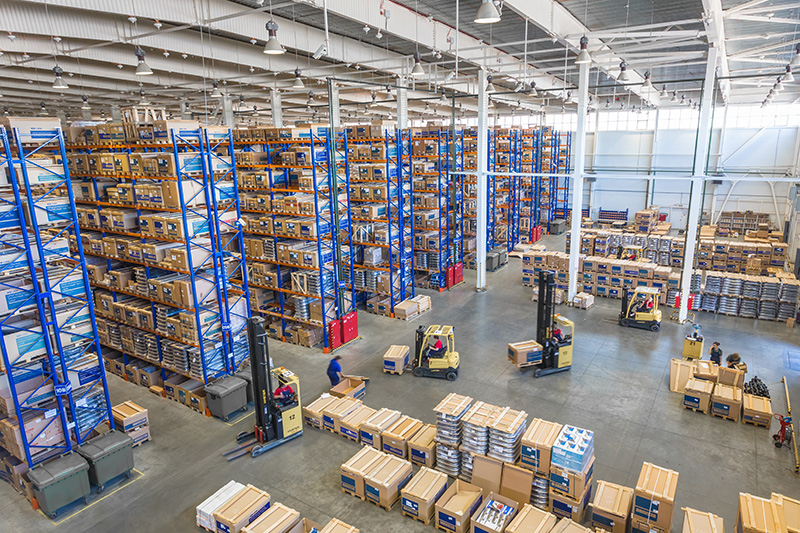
An end-of-line bottleneck is the stage of your packing, palletising, wrapping, or despatch process that limits the output of your entire production line. However fast the rest of your line runs, it can only ever produce at the rate of its slowest stage — which is why finding that stage is one of the most valuable exercises any manufacturer can carry out.
Most production lines are carefully measured and monitored at the front end. Filling speeds, packing rates, and machine performance are all tracked closely. Yet it is very often the end of the line — where products are boxed, palletised, wrapped, and moved away — where output quietly slips. Because this part of the process is frequently more manual and less instrumented than the rest of the line, a production line bottleneck here can go unnoticed for a long time, and its cost can be far greater than it first appears.
The good news is that end-of-line bottlenecks are usually straightforward to find once you know what to look for. Below, we walk through the practical steps we recommend to any manufacturer who suspects their line is capable of more than it is currently delivering.
The Common Signs of an End-of-Line Bottleneck
Before any measurement, there are some telltale signs that your end-of-line packaging process is holding your line back. The most common signs of an end-of-line bottleneck are:
- Product or boxes regularly accumulating ahead of one particular station
- Upstream machines frequently stopping because the line behind them is “blocked”
- Downstream equipment or operators intermittently standing idle, waiting for work
- Output falling away in the second half of a shift as manual handling fatigue sets in
- The line coping at average demand but struggling at peak or on your fastest products
If one or more of these sounds familiar, the following steps will help you pinpoint exactly where the constraint lies.
Start by Walking the Line
It sounds simple, but the single most valuable first step is to stand at the end of your line and watch it run for a full shift, or as much of one as you can. Not for five minutes — bottlenecks often hide during short observations and only reveal themselves over time.
As you watch, ask yourself a few questions. Where is product accumulating? Where are operators waiting? Where is equipment sitting idle? A build-up of boxes ahead of a workstation, or an operator standing empty-handed downstream of one, are both telling you the same thing: the constraint is somewhere in between.
Look for the Queue and the Gap
Every bottleneck produces two signatures. Immediately upstream of it, you will see a queue – product backing up, conveyors running full, or totes and boxes stacking on the floor. Immediately downstream, you will see a gap – equipment or people intermittently starved of work.
If boxes are accumulating before your palletising station while the stretch wrapper beyond it stands idle, the palletising step is your constraint. If pallets are queuing for the wrapper instead, the constraint has moved. Finding the point where “full” turns to “empty” is the quickest way to locate a bottleneck without any measurement equipment at all.
Measure the Rate at Each Stage
Observation will point you in the right direction, but numbers will confirm it. Take each stage of your end-of-line process in turn — case packing, check weighing, labelling, palletising, wrapping, and despatch — and measure the actual sustained rate of each, in units per hour, across a realistic period.
The word sustained matters here. A stage that runs quickly for ten minutes and then stops for five is not delivering its headline rate. What you are looking for is the true average output over a full shift, including all the stops, changeovers, and interruptions that happen in real production. Your bottleneck is simply the stage with the lowest sustained rate — and your whole line can only ever run as fast as that stage allows.
Don’t Overlook the Human Factors
At the end of the line, people are very often doing the heaviest and most repetitive work in the factory — lifting boxes, stacking pallets, and moving loads. This introduces a type of bottleneck that machinery does not suffer from: fatigue.
An operator hand-stacking pallets may comfortably match the line speed at 8am, but by mid-afternoon the rate naturally drops. Breaks, rotation, fatigue, absence, and the ongoing difficulty of recruiting for manual roles all affect end-of-line output in ways that a spot check will never reveal. If your line consistently produces less in the second half of a shift than the first, manual handling at the end of the line is a very likely cause.
Check Your Downtime Records
If you keep downtime logs, they are a rich source of evidence — but read them carefully. It is common for downtime to be recorded against the machine that stopped, rather than the machine that caused the stop. A filler that halts because the line behind it is backed up will appear in the log as filler downtime, when the real culprit may be a palletising station much further downstream.
Wherever you see repeated “blocked” or “waiting” entries, trace them back to their source. Bottlenecks at the end of the line have a habit of showing up as apparent problems everywhere else.
Watch What Happens at Peak
Many end-of-line processes cope perfectly well at average demand and fail at peak. If your bottleneck only appears during your busiest weeks, seasonal ramps, or when running your fastest products, it is no less real — it is simply intermittent. Make sure your observations and measurements include your most demanding production scenarios, not just a typical day, because it is at peak that a bottleneck costs you the most.
Beware of Moving the Problem
One final word of caution: bottlenecks move. Speed up your palletising and the constraint may shift to your stretch wrapper; automate your wrapping and it may shift to how quickly finished pallets are moved to storage. This is entirely normal, and it is why we always encourage customers to look at their end-of-line process as a whole system rather than a series of isolated stations. The goal is a balanced line, where every stage — including the transport of finished pallets away from it — can comfortably sustain the rate the line demands.
How to Fix an End-of-Line Bottleneck
In our experience, the end-of-line bottleneck most commonly turns out to be palletising — either a manual operation that cannot sustain the line rate across a full shift, or an older machine that stacks quickly on paper but stops frequently in practice. The second most common is pallet logistics: full pallets not being moved away fast enough, so the palletiser itself ends up blocked.
Both are very solvable. The most effective way to remove an end-of-line bottleneck is to automate the constraining stage — most often with a robotic palletising system that can sustain the line rate hour after hour without fade, supported by AMRs that keep finished pallets flowing away from the line automatically. Just as importantly, a well-specified system is designed to a realistic, agreed throughput target — with headroom for real-world variation — and proven against that target before it ever reaches your factory floor.
Talk to Us
If you suspect there is a palletising bottleneck in your end-of-line process, or you have found one and would like help removing it, we would be very happy to talk it through with you. We can help you assess your current line, identify where the constraint really lies, and recommend the right solution — whether that is a cobot, compact, modular or prebuilt palletiser, AMRs to move your pallets, or a combination.
Do get in touch with the Granta team on 01223 499488 or email helpline@granta-automation.co.uk, and achieve with automation.
Get in touch with our team on 01223 499488 or email helpline@granta-automation.co.uk, and achieve with automation.
Watch automation videos…
Find out more…
- How Many AMRs Do I Require?
- Why Your Competitors are Faster: 3 Productivity Gaps in UK Warehousing
- Solving the Recruitment Crisis: Why Fewer Young Workers Are Choosing Manual Packing Roles
- Manual vs Automated Palletising: ROI & Cost Comparison Guide
- Why Staff Love Using Granta Easy Programming Palletiser Software
 Bag Palletiser
 Barrel Palletiser
 Box Palletiser
 Crate Palletiser
 Tray Palletiser