It is one of the first questions we are asked when a customer starts thinking about Autonomous Mobile Robots, and it is a very sensible place to begin. After all, the number of AMRs you deploy has a direct bearing on both the performance of your operation and the cost of your project.
The honest answer is that there is no single number that fits every facility. The right fleet size depends on how much you need to move, how far it has to travel, and how quickly it all needs to happen. The good news is that working it out is far more straightforward than it might first appear. Below, we walk through the main factors that determine how many AMRs you require, and how we help you arrive at the right figure.
Start With the Work, Not the Robot
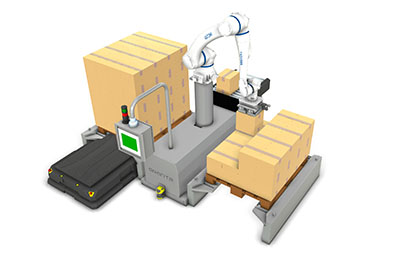
Before counting robots, it helps to be clear about the job they are doing. In most of our applications, AMRs are moving pallets — typically taking full pallets away from a palletising system to a storage area, and often returning empty pallets back into the system.
The key number here is your throughput: how many pallets (or loads) need to be moved in a given period, usually expressed per hour. A line producing 30 full pallets an hour places very different demands on a fleet than one producing 80. Establishing this figure first gives us a solid foundation for everything that follows.
How Long Does One Full Cycle Take?
The next thing to understand is the cycle time of a single AMR — the time it takes to complete one full job and be ready for the next. A typical cycle includes:
- Travelling to the pickup point
- Loading the pallet
- Travelling to the drop-off point
- Offloading the pallet
- Returning, ready for the next task
Add these together and you have the time for one round trip. If for example a single cycle takes around five minutes, one AMR can complete roughly twelve moves an hour in ideal conditions. Compare that figure against your required throughput and the rough shape of your fleet begins to emerge.
What About Charging?
A common worry is that charging will eat into the working day, but in practice it rarely causes a headache. AMRs and AGVs charge themselves automatically: whenever there is no works order waiting, the robot simply takes itself off to a charging station and tops up, then returns to work the moment it is needed again. The charging happens in the quiet spells, not in the middle of a job.
For a standard single shift — a normal eight-hour day — many operations manage perfectly well without any dedicated charging time at all, unless usage is exceptionally heavy. It is really only as you move towards continuous, 24/7 running that charging starts to take a meaningful slice out of available time.
Plan for Your Peaks, Not Just Your Average
Many operations have a steady average demand but experience busier spells — a shift changeover, a surge of orders, or simply the natural rhythm of a production day. If you size your fleet purely around the average, those peaks can create bottlenecks.
We always recommend looking at your busiest realistic period and making sure the fleet can comfortably cope. Adding one robot of headroom for peaks and redundancy is often a worthwhile investment; it means that if demand spikes, or if one AMR is taken out for maintenance, your operation keeps flowing.
Consider Layout, Distance and Traffic
The physical layout of your facility matters a great deal. Longer travel distances increase cycle times, which in turn increases the number of robots needed to hit the same throughput. The number of pickup and drop-off points, the width of aisles, and how much other traffic shares the space all play their part too.
This is where intelligent fleet software earns its keep. Our AMRs are managed by the GoControl system, which receives, prioritises and dispatches jobs automatically, routing each robot efficiently and re-planning around obstacles. Well-managed traffic means each AMR spends more of its time working and less of it waiting — which can reduce the number of robots you ultimately need.
Think About Tomorrow as Well as Today
It is always worth asking where your operation is heading. One of the great advantages of AMRs is their scalability — you are not locked into a fixed installation. If your volumes grow, you can add robots to the existing fleet, and the software will simply incorporate them.
For that reason, many of our customers choose to start with the fleet that meets today’s needs while keeping a clear plan for expansion. You get the benefits now without over-investing, and a straightforward route to grow when the time is right.
A Simple Way to Estimate
There are two ways we tend to approach this — a quick rule of thumb, and a more detailed calculation.
The quick rule of thumb
A conservative starting point is to look at how the work is done today. As a rough guide, for every forklift operator currently moving your pallets, you will need approximately 1 to 1.5 AMRs or AGVs. It is not exact, but it gives you a sensible ballpark in seconds.
The more detailed method
For a closer estimate, we work through the cycle in a little more detail:
- Allow a travel speed of around 1 metre per second, and measure the distances the robot will cover on a typical job.
- Add one minute for each pallet pick-up and one minute for each drop-down.
- Multiply the resulting capacity by 0.85, to allow 15 per cent for charging time.
- Finally, apply a route congestion factor to account for traffic and shared space, using the table below.
| Route Congestion Factor | Description |
| 1.00 | Wide lanes, more than 3m per AMR/AGV, with no other congestion |
| 0.80 | Wide lanes, more than 3m per AMR/AGV, but shared with people / forklifts |
| 0.95 | Narrow lanes, 2–3m wide per AMR/AGV, with no other congestion |
| 0.70 | Narrow lanes, 2–3m wide per AMR/AGV, but shared with people / forklifts |
| 0.10 | Very narrow lanes, less than 2m (and no less than 1.6m) |
Where lanes are not wide enough for two AMRs/AGVs to pass, also add a waiting time factor to allow for passing places — for example, 0.90 if you estimate the robot will be waiting around 10 per cent of the time.
This gives a realistic view of how many moves each robot can achieve in an hour, and therefore how many robots you need to meet your throughput.
It is a helpful guide, but every facility is different, and small changes in layout or process can shift the answer. That is why we never rely on a rule of thumb alone for a final specification.
The Best Answer Comes From Working It Out Together
Sizing an AMR fleet well is part calculation and part experience. By understanding your throughput, your layout and your goals, we can model the right number of robots for your operation — enough to keep things moving smoothly, without paying for capacity you do not need.
If you would like help working out how many AMRs your operation requires, we would be very happy to talk it through and put together an estimate tailored to your facility. Please do get in touch on 01223 499488 or email us at helpline@granta-automation.co.uk. We will be very happy to help.
Watch automation videos…
Find out more…
- Is Your Warehouse Slowing Down? How to Spot Hidden Bottlenecks in Packing and Shipping
- The Granta Advantage: KUKA Platinum Status + Patented Software = Smarter Automated Palletising
- Why Granta Palletisers are the Preferred Choice for Contract Packers
- 5 Ways Automation Can Solve the UK’s Manufacturing Labour Shortage
- The Compact Palletiser: Big Performance in a Small Footprint
 Bag Palletiser
 Barrel Palletiser
 Box Palletiser
 Crate Palletiser
 Tray Palletiser