A single robotic palletiser can handle product from multiple production lines – and equally, there is nothing wrong with giving every line its own robot. Both approaches work, both are proven, and we design and build both. The right choice comes down to three things: speed, space, and access.
When we visit customer sites, one of the most common things we hear is surprise that a robot palletiser can take more than one input at all. Many people assume it is one robot, one line, full stop. In reality, there are several well-established ways to feed multiple lines into one robot. Here they are – along with an honest look at when each one makes sense.
The Configurations Most People Don’t Realise Exist
Multiple infeed conveyors into one robot. A robot cell with an infeed conveyor from each line, and pallet positions or pallet conveyors as outputs. A typical layout has the robot in the centre with one or two conveyors on each side. One thing to be aware of: robot reach sets a physical limit. As a rule of thumb, a static robot can serve up to six – at most seven – pallet positions plus an infeed. You certainly couldn’t pick off eight infeed conveyors and place onto eight pallets; the robot simply wouldn’t reach. Beyond that point, you need a track system.
One collated infeed, many products. You don’t necessarily need a conveyor per line. Several lines can be merged onto a single infeed conveyor, with a barcode reader at the end identifying each product as it arrives. The robot then stacks each item – trays, boxes, bags, shrink-wrapped packs – onto its correct pallet. We have systems in the field built exactly this way: one infeed feeding a robot surrounded by a ring of six pallets, with every product automatically placed on the right stack.
Track-mounted robots for large pallet counts. A static robot runs out of reach at around six or seven pallet positions. Need more than that? You have two options: add extra palletisers, or – if the rates are slow enough – mount one robot on a sliding track. A track-mounted robot typically serves from around seven pallet positions upwards: that could be seven, twenty, thirty or more, with no real limit other than floor space, because the track can simply be made longer.
How the Options Compare
| System style | Speed | Space | Things to consider |
| One robot per line | Fastest per line. With row gripping and auto-rotation, a dedicated robot can keep up with lines running at 30–50 products a minute. | A cell at the end of every line. Access between lines stays open. | Highest total cost if you have many lines – but maximum flexibility and redundancy. If one cell stops, the other lines keep running. |
| One robot, multiple infeed conveyors | Good. Each conveyor carries one product type in sequence, so the robot can row pick – placing several products per move. The robot’s total capacity is shared across the lines. | One cell instead of several. Each line needs its own conveyor into the cell, plus buffering space for products to accumulate while the robot serves the other lanes. | Robot reach is the limit – a static robot can serve around six or seven pallet positions plus an infeed at most. Connecting conveyors can block access between lines. |
| One robot, single collated infeed (barcode sorting) | Slower. Mixed products arrive in random order, so row picking isn’t possible – every pick is one at a time, and that caps the speed. | Very compact at the robot – e.g. a ring of six pallets around one cell, with only one conveyor into it. The merging of lines happens upstream. | Best suited to lower-rate lines. A barcode reader at the end of the infeed identifies each product so it lands on the correct pallet. The merging conveyors can block access between lines – and a fault on the shared infeed (a broken belt, say) stops every line feeding it. |
| Track-mounted robot | Slowest. Every pick is individual, plus travel time along the track between pallets. | Takes over where a static robot runs out of reach – typically from around seven pallet positions upwards. That could be 7, 20, 30 or more; the only limit is floor space for the track. | Ideal for slow sorting applications, such as dispatch areas where mixed products need distributing across many pallets. |
Speed: The Biggest Deciding Factor
Speed decides more than anything else. A single line running at thirty, forty or fifty products a minute can max out a robot entirely on its own – that line needs its own dedicated palletiser. At the other extreme, one robot can comfortably serve many slow lines; as a rough guide, around eight lines each running at a bag a minute is well within reach.
How products arrive matters just as much as how fast. Wherever the same product arrives in sequence – on a dedicated line, or in a multi-infeed cell where each conveyor carries one product type – the robot can row grip: picking a whole row of identical products in one move. This is where our patented easy programming software gives Granta systems a genuine edge; it is the only software able to automatically group picks into rows, with auto-rotation, multiplying throughput because every robot move places several products.
But here is the catch with a collated infeed: when products from different lines arrive one by one and mixed together, row gripping is not normally possible – rows need the same product in order. A mixed infeed effectively fixes your speed at one pick at a time. In theory you can add buffering before the lines merge and release products in batches ready for row picking, but this is very technical, often challenging, and rarely practical. If lines are merged onto one conveyor, plan around individual picks.
Space and Access: The Practical Realities
Space can point you either way. A single robot with six pallet positions, or even a big track-mounted system, can be far more compact than the equivalent done manually or with a machine per line – or it can occupy more space. It depends entirely on your current layout, which is why we always start by looking at the site itself.
Access is the factor people most often overlook. Joining several line ends together with conveyors physically blocks the routes between your production lines. If operators need to walk between lines – to reach a box erector, for example – a run of connecting conveyors is in the way. There are good solutions: drawbridge-style conveyors that lift for access, step-over platforms where only personnel access is needed, or high-level conveyors – such as a spiral up and over the walkway. But all of these need designing in from the start.
Finally, resilience. With a shared system, all the connected lines depend on the same equipment – if a belt breaks on a shared infeed conveyor, every line feeding that cell stops until it’s fixed. With a robot per line, only the affected line stops.
So Which Should You Choose?
Fast lines deserve their own robots. Slow lines can share one – and save a lot of money and floor space doing it. If you need to sort onto a large number of pallets, a track-mounted robot will do it at a gentler pace. And in every case, check the practicalities early: robot reach, buffering space, and how operators will move around the cell.
We genuinely don’t mind which way you go – we design, build and support all of these configurations, and our job is to recommend the one that fits your products, speeds and layout.
If you’d like to talk through which configuration would suit your operation, get in touch with us on 01223 499488 or email helpline@granta-automation.co.uk. You can also use our Palletiser Savings Estimator to get an indication of the return you could expect.
Watch automation videos…
Find out more…
- How Many AMRs Do I Require?
- Why Your Competitors are Faster: 3 Productivity Gaps in UK Warehousing
- Solving the Recruitment Crisis: Why Fewer Young Workers Are Choosing Manual Packing Roles
- Manual vs Automated Palletising: ROI & Cost Comparison Guide
- Why Staff Love Using Granta Easy Programming Palletiser Software
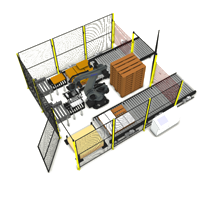 Bag Palletiser
 Barrel Palletiser
 Box Palletiser
 Crate Palletiser
 Tray Palletiser