If you manage a bustling UK warehousing or manufacturing site, you know that keeping up with shifting consumer demands is harder than ever. You might look at the competition and wonder how they manage to despatch orders at lightning speeds, scale up smoothly during peak times, and protect their margins against soaring operational pressures.
The reality is that your competitors aren’t necessarily working harder—they have identified and closed structural efficiency gaps that drag down traditional operations. In British logistics, productivity is often won or lost at the end-of-line and intralogistics workflows.
Below are three specific productivity gaps that may be holding unautomated operations back, alongside the actionable steps needed to close them.
1. The Human Velocity Cap: Manual Palletising Bottlenecks
A common misconception in warehousing is that throughput is determined by the speed of your processing or picking lines. However, a major hidden drain on your bottom line is the packing and palletising hall.
When product stacks up at the end of the line, your entire operation has to slow down to prevent a backlog. Relying on manual labour to stack boxes, containers, or heavy sacks creates a “Human Velocity Cap”:
- The Fatigue Curve: A human operator might start a shift performing at peak speed, but fatigue inevitably sets in. By hour six or seven, manual handling slows down, creating an unpredictable operational flow.
- The High Churn Cycle: Manual palletising is repetitive and physically gruelling. Warehouses face heavy costs from constant staff turnover in low-skilled packing departments, resulting in endless recruitment and agency fees.
- Health and Safety Liability: Repetitive strain and back injuries from lifting heavy boxes are an ongoing risk. A single health and safety claim can damage your team’s morale and drain unexpected capital.
Closing the Gap
Transitioning to an industrial robotic palletising system or a cobot palletiser replaces physical strain with continuous, predictable operation. Industrial robots don’t require breaks, don’t call in sick, and maintain a consistent speed 24 hours a day, 7 days a week. This forced takt time normally yields an immediate production increase of around 40%.
2. The Dead-Time Drain: Manual Intralogistics and Forklift Congestion
How much time do your warehouse associates spend simply walking across the floor, waiting on instructions, or moving empty pallets? In many traditional UK layouts, materials travel much further than necessary.
Relying entirely on manual forklifts or pallet trucks to ferry goods between the end-of-line packaging bay and the despatch docks introduces major inefficiencies:
- Traffic & Congestion: Busy shift hours create bottlenecks in high-traffic aisles. If one forklift is delayed, downstream stations are left waiting on empty inputs.
- Underutilised Skilled Labour: When an employee spends half their shift acting as a basic transport mechanism, you are paying skilled wages for low-value travel time.
| Transport Method | Flexibility | Safety Profile | Speed & Routing |
| Manual Forklift | High, but limited by operator availability | Risk of collision in narrow or busy aisles | Prone to human delays and congestion |
| Fixed Conveyors | Low; requires permanent floor-space | High safety, but creates physical layout barriers | Constant speed, but completely rigid |
| Autonomous Mobile Robots (AMRs) | Medium/High; maps can be edited in minutes or AMRs can automatically recalculate routes instantly | 360° laser sensors and 3D cameras for human safety | Smart navigation; automatically reroutes around obstacles |
Closing the Gap
Deploying a fleet of Autonomous Mobile Robots (AMRs) or Automated Guided Vehicles (AGVs) bridges the distance gap. Rather than overhauling your physical infrastructure with rigid, fixed conveyor lines, intelligent AMRs can seamlessly integrate into your current layout. They handle the heavy lifting and cross-floor transport automatically, allowing your human staff to focus on high-priority, value-added tasks.
3. The Flexibility Friction: Rigid Equipment vs. Rising SKU Counts
With rising SKU counts and tighter production schedules, modern warehouses must be highly agile. If it takes your team 30 minutes to manually reconfigure a packing line or reprogram an old mechanical stacker for a new box size, you are losing valuable throughput to planned downtime.
A rigid end-of-line system forces you into batch picking dependencies and downstream sorting areas that eat up valuable real estate.
Closing the Gap
Modern robotic palletisers feature advanced, intuitive software that enables operators to switch between product sizes or pallet stack patterns in less than 5 minutes without advanced technical training. The most sophisticated systems take this a step further with fully automated programming, where the palletiser automatically measures each incoming box and generates the optimal stacking program for the robot itself—eliminating manual setup entirely. High-performance systems can handle multi-infeed layouts—meaning a single robot cell can accept products from two or more distinct lines and simultaneously build different stack patterns on separate pallet positions.
Factoring in the “Cost of Inaction”
When evaluating automation, many finance directors look at a basic calculation: Cost of Machine ÷ Monthly Wages Saved.
To see the true Return on Investment (ROI), you must factor in the hidden operational drains: the price of product damage, agency premiums during seasonal peaks, missed growth opportunities due to labour caps, and the floor space saved by eliminating sorting zones. When these factors are calculated, the payback period for a modular palletising cell is often less than one year.
Closing these three productivity gaps isn’t about out-working the competition—it’s about de-risking your future with flexible, scalable infrastructure.
You may find the following tools useful in helping you to calculate the ROI of an automated palletising system.
- Palletiser Savings Estimator – https://www.granta-automation.co.uk/palletiser-savings-estimator
- Automation Project Payback Calculator – https://www.granta-automation.co.uk/automation-project-payback-calculator
- Intangible Benefits Calculator – https://www.granta-automation.co.uk/news/how-to-define-the-value-of-intangible-benefits/
Watch automation videos…
Find out more…
- Is Your Warehouse Slowing Down? How to Spot Hidden Bottlenecks in Packing and Shipping
- The Granta Advantage: KUKA Platinum Status + Patented Software = Smarter Automated Palletising
- Why Granta Palletisers are the Preferred Choice for Contract Packers
- 5 Ways Automation Can Solve the UK’s Manufacturing Labour Shortage
- The Compact Palletiser: Big Performance in a Small Footprint
 Bag Palletiser
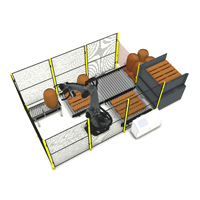 Barrel Palletiser
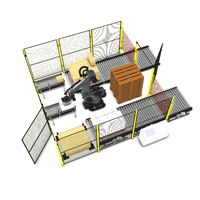 Box Palletiser
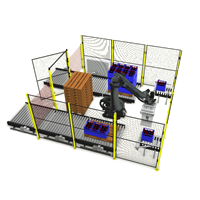 Crate Palletiser
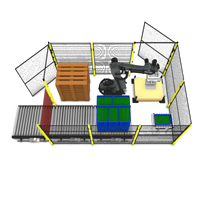 Tray Palletiser