When manufacturers compare robotic automation systems, the spec sheets all shout about the same things: cycle speed, payload capacity, reach, repeatability. These numbers matter — but they’re not what determines whether your automation project succeeds or fails.
The metric that actually decides your return on investment is one that rarely appears on a datasheet: ease of use.
A robotic palletiser that stacks 30% faster on paper but sits idle every time a product changes — because nobody on shift knows how to reprogram it — is slower in practice than a simpler system your operators can run confidently every day. In today’s world of manufacturing, usability isn’t a nice-to-have. It’s the number one predictor of real-world performance.
What Does “Ease of Use” Actually Mean in Robotics?
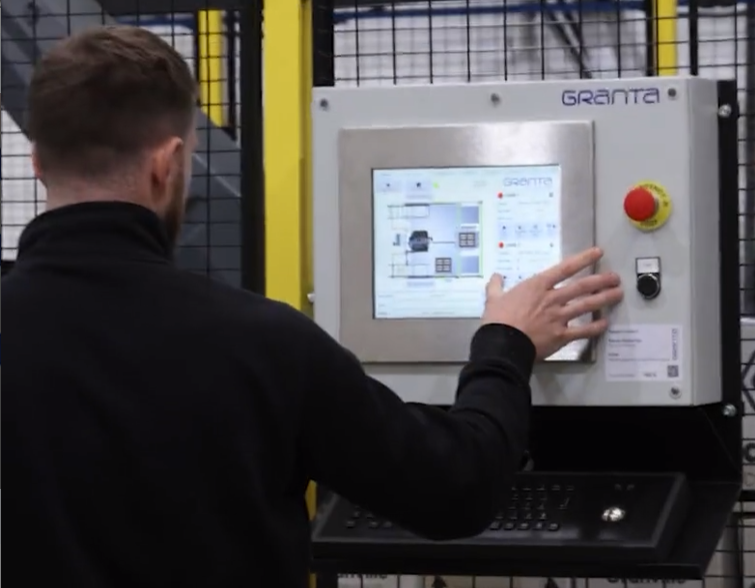
Ease of use in robotics means that the people who work with the system every day — line operators, shift supervisors, warehouse staff — can set up, run, adjust, and recover the system without needing a specialist robot programmer.
In practical terms, an easy-to-use robotic system should allow your team to:
- Set up a new product run in minutes, not days
- Change stack patterns or product sizes without writing code
- Recover from a stoppage quickly and confidently
- Train new operators in hours rather than weeks
If any of those tasks requires an external engineer or a six-figure specialist on the payroll, the system isn’t easy to use — no matter how impressive its speed figures are.
Why Ease of Use Beats Speed, Payload and Every Other Spec
1. Downtime is where ROI goes to die
Robotic palletisers only generate returns while they’re running. With traditional palletising software, introducing a single new stack pattern can take a trained specialist one to two days of coding and testing. If your production runs are getting shorter and your SKU count is growing — as it is for most manufacturers — those programming delays compound into serious lost output.
An easy-to-use system flips that equation. When operators can switch between product sizes or pallet layouts in minutes, changeovers stop being a bottleneck and utilisation stays high. That’s the difference between a payback period measured in years and one measured in months.
2. The skills shortage is real — and it isn’t going away
The UK manufacturing sector faces a persistent shortage of skilled engineers and robot programmers. According to the Institution of Engineering and Technology’s 2025 Skills Survey, 76% of engineering employers struggle to recruit for key roles — with automation among the top digital skills they need for growth. And the gap isn’t closing: EngineeringUK estimates the UK needs more than 173,000 new engineers and technicians every year through 2030 just to meet demand.
Building your automation strategy around scarce, expensive specialist skills is therefore a risk. If the one person who can reprogram your robot is on holiday, off sick, or leaves the business, production grinds to a halt.
Systems designed for ease of use remove that single point of failure. The benchmark to look for: if an operator can use a modern smartphone, they should be able to program the palletiser. That’s how you future-proof automation against a tight labour market.
3. Operator adoption makes or breaks the project
The most common reason automation projects underdeliver isn’t technical failure — it’s human resistance. When a new system is intimidating, staff work around it, blame it, or quietly stop using its capabilities. When a system is intuitive, operators feel empowered and take ownership of it.
Easy programming also delivers something spec sheets can’t measure: it moves people away from repetitive, injury-prone manual lifting and into supervisory roles. Manufacturers who automate palletising with genuinely usable systems routinely see manual handling injury claims fall to zero — and a happier, more stable workforce alongside.
4. Flexibility is the new productivity
Modern production is defined by shorter runs, more SKUs, and faster product changes. A “fast” robot that takes days to reprogram is optimised for a manufacturing world that no longer exists.
The latest developments in palletising software show where the industry is heading: systems that automatically generate optimised stack patterns from product dimensions, visual drag-and-drop pattern editors, and even fully automatic programming using laser measurement — where the system detects a new product size as it enters the cell and offers to create a new stack pattern itself, with no programming input at all.
That level of usability makes automation viable even for very short production runs — as little as a single pallet load — which was previously impossible because setup time was prohibitive.
How to Evaluate Ease of Use Before You Buy a Palletiser
Speed and payload are easy to compare. Usability takes slightly more digging, but these questions will reveal it quickly:
- Who programs a new product? If the answer involves a service call or a specialist engineer, walk away — or budget for that dependency forever.
- Does it offer genuinely easy programming? How long does a new stack pattern take? Minutes is the modern standard. Hours or days is legacy technology. Look for easy programming features like automatic stack pattern generation – operators should never need to touch code.
- How long does operator training take? A genuinely usable system should have a new operator confident within a shift.
- What does fault recovery look like? Clear on-screen guidance beats an error code and a manual.
- Ask to see it live. A demonstration — ideally with one of your products — will tell you more about ease of use than any brochure.
The Bottom Line
Speed, payload and reach tell you what a robot can do in perfect conditions. Ease of use tells you what it will actually do on your factory floor, on a wet Tuesday, with a new starter on shift and a product changeover due before lunch.
When you evaluate robotic palletising systems, put usability at the top of your criteria — because the best palletiser isn’t the one with the most impressive spec sheet. It’s the one your team actually uses, every day, at full capacity.
FAQs: Ease of Use in Robotic Palletising
What is the most important factor when choosing a robotic palletiser? Ease of use. A palletiser your own operators can program and run without specialist support delivers higher real-world utilisation, faster changeovers, and a shorter payback period than a faster system that depends on external programmers.
Do you need a robot programmer to run a robotic palletiser? Not with modern systems. Easy-programming palletiser software allows operators with zero coding experience to set up a new product run in under five minutes, using automatically generated stack patterns or a visual drag-and-drop editor.
How long does it take to set up a new product on an easy-to-use palletiser? With modern easy-programming software, typically under five minutes. With fully automatic laser-measuring systems, the palletiser can detect a new product size itself and generate a new stack pattern with no manual programming at all.
Are easy-to-use palletisers suitable for short production runs? Yes. Because setup time is measured in minutes rather than days, automated palletising is now viable for very short runs — even a single pallet load.
Do easy-to-use palletisers reduce workplace injuries? Yes. By making automation simple enough for every operator to run, staff move away from repetitive manual lifting. Manufacturers automating palletising have reduced manual handling injury claims to zero.
Want to see just how easy palletising automation can be?
At Granta Automation, every one of our robotic palletising systems — from cobot palletisers to compact and modular systems — comes with our patented easy-programming software . Anyone who can use a smartphone can set up a product run in under five minutes.
Try our palletiser savings calculator to see your predicted ROI, or book a free site visit on 01223 499488 and we’ll assess your requirements and show you how simple automation can be.
Watch automation videos…
Find out more…
- Is Your Warehouse Slowing Down? How to Spot Hidden Bottlenecks in Packing and Shipping
- The Granta Advantage: KUKA Platinum Status + Patented Software = Smarter Automated Palletising
- Why Granta Palletisers are the Preferred Choice for Contract Packers
- 5 Ways Automation Can Solve the UK’s Manufacturing Labour Shortage
- The Compact Palletiser: Big Performance in a Small Footprint
 Bag Palletiser
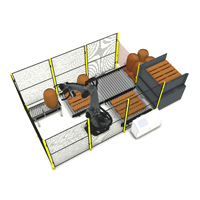 Barrel Palletiser
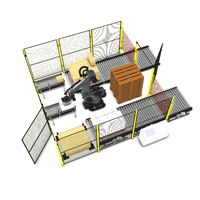 Box Palletiser
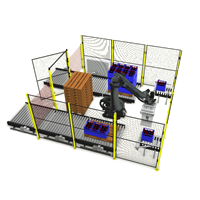 Crate Palletiser
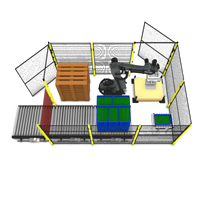 Tray Palletiser