Scaling production is often assumed to require one thing above all else: more people. More operators, more supervisors, more support staff. But in today’s manufacturing environment — where margins are under constant pressure and labour is increasingly difficult to recruit and retain — the most competitive factories are taking a different approach.
They’re scaling output without scaling headcount.
This isn’t about cutting corners or overburdening teams. It’s about unlocking the latent capacity that already exists within your operation. With the right combination of process visibility, targeted investment, and continuous improvement, manufacturers can significantly increase throughput using the people, equipment, and space they already have.
Here’s how to do it effectively — and sustainably.
1. Start With Process Visibility
Before making any changes, you need a clear, objective view of how your factory is actually performing — not how it’s assumed to perform.
Many operations rely on anecdotal feedback or end-of-shift reporting, which often masks inefficiency. Machines may appear busy but spend significant time idle between cycles. Operators may be working hard but not necessarily working efficiently. Small delays — waiting for materials, searching for tools, rechecking work — accumulate quickly.
Introducing real-time monitoring transforms this picture. Whether through a full Manufacturing Execution System (MES), IoT-enabled machine tracking, or well-designed manual dashboards, visibility allows you to:
- Measure actual cycle times against standard times
- Identify recurring downtime patterns and their root causes
- Highlight performance variation between shifts or lines
- Detect micro-stoppages that typically go unrecorded
This insight creates a foundation for improvement. Instead of guessing where capacity is being lost, you can target specific, measurable issues — and track the impact of changes over time.
2. Eliminate Bottlenecks First
Every production system has a limiting factor — a single step that constrains overall output. This bottleneck dictates the maximum capacity of your entire operation.
A common mistake is trying to improve everything at once. In reality, increasing speed in non-constrained areas simply creates more work-in-progress and inefficiency downstream.
Instead, focus on the constraint. In many factories, the end of the production line is exactly where this pressure builds — palletising and packing operations that rely on manual labour are frequently the slowest, most variable part of the process. When upstream production outpaces what operators can physically handle at the end of the line, throughput suffers and product queues up.
Ask the right questions:
- Is the bottleneck running at full capacity, or is it slowing the whole line down?
- How much of the delay is due to manual handling speed or operator fatigue?
- Are operators waiting on instructions, empty pallets, or other inputs?
- Can tasks be simplified, combined, or removed entirely?
Even modest gains at the bottleneck — reducing cycle time, cutting changeover duration, or improving consistency — can increase total output disproportionately. Once one constraint is resolved, another will emerge. Scaling effectively means continuously identifying and addressing these shifting bottlenecks.
3. Automate the Right Process First — Starting at the End of the Line
Automation is often seen as the default route to higher output — but trying to automate everything at once is expensive, complex, and rarely necessary.
The most effective approach is targeted automation: applying it where it delivers the highest and fastest return. For most manufacturers, that means starting at the end of the line.
End-of-line palletising is one of the most common and impactful targets for automation because it typically involves:
- Highly repetitive, physically demanding tasks that operators cannot sustain at pace indefinitely
- Inconsistency in stack quality, pallet patterns, and throughput rates
- A direct constraint on how fast finished goods can be moved from production to despatch
- Significant manual handling risk — one of the leading causes of workplace injury in manufacturing
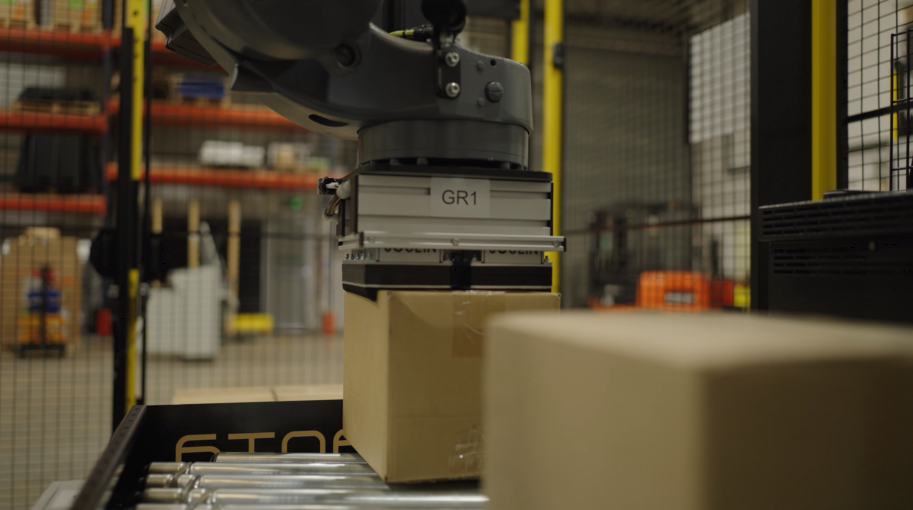
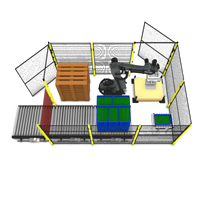
A robotic palletising system removes these problems entirely. Unlike manual operators, a palletiser runs continuously — no breaks, no fatigue, no variation. Throughput is predictable and consistent, pallet quality improves, and your team can be redeployed to higher-value tasks elsewhere in the operation.
This isn’t about replacing people — it’s about using them where they add most value, rather than on repetitive handling work that a machine can do faster and more reliably around the clock.
4. Optimise Changeovers and Reduce Downtime
One of the largest untapped opportunities in most factories lies in reducing non-productive time.
Changeovers, maintenance, and scheduling inefficiencies can quietly consume hours of potential production capacity each week. Because these activities are treated as normal, they’re rarely scrutinised as closely as they should be.
Start by analysing:
- Average changeover duration and variability
- Frequency and causes of unplanned downtime
- Maintenance response times
- Production scheduling patterns
Applying SMED (Single-Minute Exchange of Die) principles can dramatically reduce changeover times by separating internal and external setup tasks. Modern robotic palletising systems, for example, can switch between pallet patterns or product configurations in minutes — far faster than reconfiguring a manual team or adjusting a process by hand.
Shifting from reactive to preventive — or predictive — maintenance also significantly improves equipment availability. Even incremental improvements, such as reducing downtime by 10–15%, can create substantial additional capacity without adding a single operator.
5. Upskill and Redeploy Your Existing Workforce
If your goal is to scale without hiring, your current workforce is your most valuable asset — but only if they’re working where they add most value.
One of the less-discussed benefits of automated palletising is what it does for your team. Operators freed from repetitive end-of-line handling can be redeployed to roles that genuinely benefit from human judgement: quality inspection, process monitoring, equipment oversight, and continuous improvement activity.
Practical steps to maximise this include:
- Cross-training employees to operate and monitor automated systems
- Providing clear, accessible training on new equipment — modern palletisers are designed to be simple to programme and operate
- Encouraging operators to contribute ideas for process improvement
- Creating feedback loops where suggestions are reviewed and acted upon
When employees understand how their role impacts overall performance, they’re far more likely to take ownership of outcomes. Automation doesn’t diminish that — it elevates it.
6. Improve Material Flow and Factory Layout
Inefficient movement of materials is one of the most common — and most overlooked — sources of lost productivity. Every unnecessary step, delay, or manual handling process reduces the time available for value-added work.
Take a fresh look at your layout:
- Are materials travelling further than necessary?
- Do operators spend time walking between stations?
- Are there bottlenecks caused by poor positioning of equipment or storage?
- Is finished product accumulating at the end of the line because palletising can’t keep pace?
Automated Guided Vehicles (AGVs) and Autonomous Mobile Robots (AMRs) can work in conjunction with palletising systems to move loaded pallets from the palletiser directly to a wrapping station or despatch/storage area — removing the need for manual pallet truck movements and keeping the line flowing.
The objective is straightforward: ensure materials move smoothly, predictably, and with minimal manual intervention from production through to despatch.
7. Leverage Data for Continuous Improvement
Scaling output isn’t a one-off initiative — it’s an ongoing process.
The most effective manufacturers build a culture of continuous improvement, supported by data. Rather than relying on periodic reviews, they monitor performance in real time and make frequent, incremental adjustments.
Key metrics to track include:
- Overall Equipment Effectiveness (OEE)
- Throughput rates
- Downtime frequency and duration
- Quality and rework levels
Modern palletising systems provide real-time performance data as standard — giving supervisors and engineers immediate visibility of cycle times, output rates, and any stoppages. This data can be fed into wider factory monitoring systems, creating a clear picture of end-to-end performance and making it far easier to identify where further improvements are possible.
8. Standardise and Document Best Practices
Consistency is a prerequisite for scalability.
If processes vary between shifts, operators, or production lines, output will always be unpredictable. Standardisation ensures that the most efficient way of working is applied consistently across the operation.
This includes clear work instructions, visual aids, standard operating procedures, defined quality standards, and regular reviews to keep processes current.
One often-overlooked benefit of automating palletising is that it enforces standardisation by default. Every pallet is built to the same pattern, at the same speed, to the same specification — regardless of which shift is running. That consistency ripples back through the operation, making scheduling more reliable and despatch more predictable.
Final Thoughts
Scaling factory output without hiring more people isn’t about pushing your existing workforce harder. In fact, that approach tends to lead to burnout, quality problems, and diminishing returns.
It’s about working smarter — and starting with the right changes.
For most manufacturers, that means taking a hard look at the end of the line. Manual palletising is one of the most common constraints on factory throughput, and one of the most straightforward to address. A robotic palletising system can typically deliver payback in under 12 months, while simultaneously improving output consistency, reducing manual handling injuries, and freeing your team for higher-value work.
If you’d like to understand what palletising automation could look like in your operation, get in touch with the Granta team or use our Palletiser Savings Estimator to get an indication of the return you could expect.
Watch automation videos…
Find out more…
- The Hidden Cost of Throughput: Why Is Staff Turnover So High in My Packing Department?
- Why “Made in the UK” Matters for Support and Spare Parts
- Why Granta Palletisers Are Designed to Deliver One of the Lowest Total Costs of Ownership (TCO) in the UK
- Why We Use KUKA Robots in Our Palletising Systems: Reliability and Lifespan You Can Trust
- 10 Automation Terms Every Engineer Should Know Before Upgrading Their Production Line
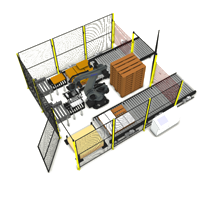 Bag Palletiser
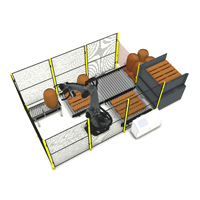 Barrel Palletiser
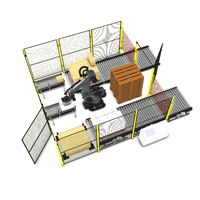 Box Palletiser
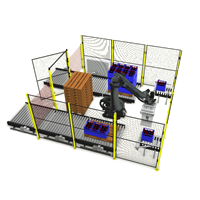 Crate Palletiser
 Tray Palletiser