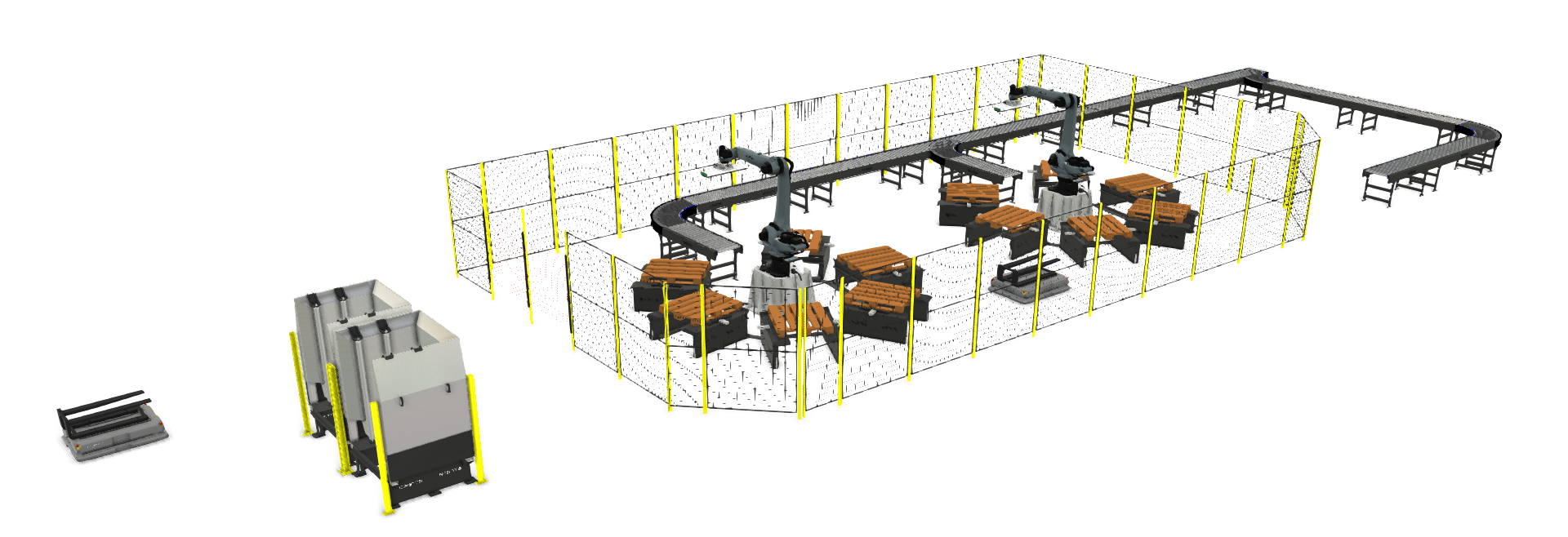
With rising SKU counts and tighter production layouts, manufacturers are looking for ways to consolidate equipment without sacrificing output. Multi‑infeed, multi‑pallet robotic palletisers provide that consolidation by enabling one robot to service several lines and pallet positions in parallel, significantly increasing operational efficiency. This capability is transforming end‑of‑line automation, especially for sites producing a wide range of SKUs or operating multiple packaging formats.
The video below shows a real system in action, demonstrating how a single robot can manage several product streams and build pallets on different stations in parallel.
Watch the system running:
Why Multi‑Infeed, Multi‑Pallet Palletising Matters
Traditional palletisers are usually dedicated to a single line. If a facility has three packaging lines, it often needs three separate palletisers—each taking up space, requiring maintenance, and adding cost.
A robotic palletiser with multi‑line capability replaces all of that with a single, flexible cell that can:
- Accept products from two or more infeed conveyors
- Build pallets on two or more pallet positions
- Switch between lines and pallets automatically
This approach increases efficiency while reducing equipment footprint.
How Robots Manage Multiple Infeeds
A robotic palletiser can receive products from several lines because of three key technologies:
1. Coordinated Infeed Conveyors
Each infeed delivers product to a defined pick point. Sensors or vision systems confirm:
- Product presence
- Orientation
- SKU type
The robot’s controller prioritises picks based on line speed, buffer levels, or programmed rules.
2. Intelligent Scheduling
The robot doesn’t simply pick from whichever line is closest. Instead, it uses logic such as:
- “Pick from Line A until buffer drops below X”
- “Alternate between Line A and Line B every cycle”
- “Prioritise the fastest‑running line to prevent backups”
This ensures smooth flow across all lines.
How Robots Build Multiple Pallets at the Same Time
Once the robot has picked a product, it must place it on the correct pallet. Multi‑pallet systems achieve this through:
1. Multiple Stacking Patterns
Each pallet position can have its own pattern, height, and SKU assignment. For example:
- Pallet 1: Cartons, interlocked pattern
- Pallet 2: Cartons, column stack
The robot switches patterns automatically based on which pallet it is feeding.
2. Optimised Robot Paths
The robot’s motion planning software calculates the most efficient route between:
- Infeed A → Pallet 1
- Infeed B → Pallet 2
- …and so on
This minimises travel time and maximises throughput.
Where This Technology Is Most Valuable
Multi‑infeed, multi‑pallet robotic palletisers are ideal for:
- Food and beverage plants
- Pet food and animal feed manufacturers
- Chemical and agricultural products
- Contract packers with frequent SKU changes
- Facilities with limited floor space
- Operations looking to reduce labour dependency
They provide the flexibility to scale production without major layout changes.
The Bottom Line
Robotic palletisers capable of handling multiple infeeds and multiple pallet stack positions simultaneously offer a powerful combination of flexibility, efficiency, and space savings. By stacking from two or more infeeds onto two or more pallet positions, they keep production flowing continuously.
The system shown in the video is a strong example of how a single robotic cell can replace several traditional palletisers while delivering higher throughput and greater adaptability.
If you’d like to understand how automated palletising could work in your operation, get in touch with us or use our Palletiser Savings Estimator to get an indication of the return you could expect.
Watch automation videos…
Find out more…
- The Hidden Cost of Throughput: Why Is Staff Turnover So High in My Packing Department?
- Why “Made in the UK” Matters for Support and Spare Parts
- Why Granta Palletisers Are Designed to Deliver One of the Lowest Total Costs of Ownership (TCO) in the UK
- Why We Use KUKA Robots in Our Palletising Systems: Reliability and Lifespan You Can Trust
- 10 Automation Terms Every Engineer Should Know Before Upgrading Their Production Line
 Bag Palletiser
 Barrel Palletiser
 Box Palletiser
 Crate Palletiser
 Tray Palletiser