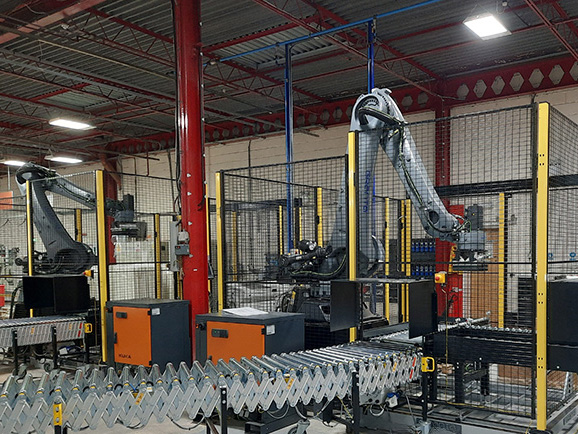
Integrating a palletiser into an existing production line is far more than a simple equipment installation. When done well, it becomes a strategic upgrade that increases throughput, reduces manual handling, and delivers consistent, reliable performance. Achieving these outcomes requires a structured approach that aligns the palletiser’s capabilities with the specific demands of your production environment.
1. Conduct a Comprehensive Production Audit
A successful integration begins with a detailed audit of your current production line. Understanding how your operation runs day‑to‑day ensures the palletiser you choose will complement—not constrain—your workflow.
Key areas to assess include:
- Throughput and Performance Metrics: Identify peak and average line speeds. If the palletiser cannot keep pace, it will create bottlenecks rather than efficiencies.
- Product Profile and Packaging Variability: Review product dimensions, weights, fragility, and packaging formats. These factors determine the required gripping tools, stacking patterns, and palletiser configuration.
- Spatial Constraints and Facility Layout: Measure available floor space, ceiling height, and access routes. Consider not only the footprint of the palletiser but also safe operator access, maintenance clearance, and potential future expansion.
- Existing Material Flow and Conveyance Systems: Map upstream and downstream product movement to identify the most efficient integration points.
A thorough audit at this stage prevents costly misalignment and ensures the palletiser enhances productivity from day one.
2. Select the Appropriate Palletiser Type
Palletisers are not one-size-fits-all solutions. The right choice depends on your product mix, throughput requirements, available space, and long-term automation strategy.
Common options include:
- Cobot Palletisers: Designed for flexibility, ease of use, and collaborative operation. Cobot palletisers are ideal for low-to-medium production volumes, frequent changeovers, and operations handling multiple SKUs. Their intuitive programming allows quick adjustment for different case sizes, weights, and pallet patterns with minimal downtime.
- Industrial Robot Palletisers: Built for high throughput, continuous operation, and heavier payloads. These systems excel in demanding environments and are well suited to facilities managing multiple SKUs at scale, offering fast changeovers, precise placement, and the ability to adapt to varying packaging formats.
Working with a supplier who can tailor the system to your exact requirements ensures optimal performance and future scalability.
3. Plan the Integration Carefully
Integration involves more than positioning a palletiser on the factory floor. It must be fully synchronised with your existing automation, control systems, and safety infrastructure.
Key considerations include:
- Conveyors and Product Feeding: Upstream conveyors must deliver products consistently, with correct orientation and spacing. Poor presentation can compromise even the most advanced palletiser.
- Automation and Control Integration: The palletiser should communicate seamlessly with your PLC or MES, enabling coordinated product flow, error detection, and real‑time data visibility.
- Safety Protocols and Accessibility: Install guards, interlocks, and emergency stops in line with safety standards, while maintaining easy access for maintenance and cleaning.
- Utility Requirements: Confirm that power supply, compressed air, and network connectivity meet the palletiser’s operational needs.
Early collaboration between engineering, production, and automation teams ensures a smooth integration and avoids delays during commissioning.
4. Commissioning and Validation
Commissioning is where the system proves itself in real‑world conditions. A structured commissioning process ensures reliability, efficiency, and long‑term performance.
Key steps include:
- Initial Trials: Test the palletiser with actual production materials to validate speed, accuracy, and pallet stability.
- Fine‑Tuning: Adjust gripping tools, stacking patterns, and cycle timings to minimise product damage and maximise efficiency.
- Operator Training: Provide comprehensive training on operation, troubleshooting, and routine maintenance to ensure confident day‑to‑day use.
- Data Synchronisation: Verify that performance data integrates correctly with your monitoring systems to support ongoing optimisation and predictive maintenance.
A well‑executed commissioning phase reduces downtime and establishes a strong foundation for long‑term reliability.
5. Optimise for Long‑Term Performance
Integration is not a one‑time event. Continuous optimisation ensures the palletiser remains efficient and adaptable as production demands evolve.
Focus on:
- Preventive Maintenance: Regular servicing reduces unexpected stoppages and extends equipment lifespan.
- Performance Monitoring: Track throughput, downtime, and error trends to identify opportunities for improvement.
- Scalability and Flexibility: Choose modular systems or upgrade paths that allow you to introduce new products, increase volumes, or expand production lines in the future.
With ongoing optimisation, the palletiser becomes a key component of a resilient, future‑ready automation strategy.
Integrating a palletiser into an existing production line is a strategic investment that strengthens efficiency, safety, and long‑term scalability. By carrying out a detailed production audit, selecting the right palletising technology, planning the integration carefully, and committing to thorough commissioning and ongoing optimisation, operational performance can be significantly enhanced.
At Granta Automation we guide all our customers through every stage of this process—from initial assessment to long‑term optimisation—ensuring the system is tailored to your exact requirements and fully aligned with your production goals. With the right partner, palletiser integration becomes more than a technical upgrade; it becomes a catalyst for measurable, lasting business improvement.
If you’d to discuss you requirements for palletising solutions, feel free to contact us on 01223 499488 or helpline@granta-automation.co.uk and we will be happy to help.
Watch automation videos…
Find out more…
- Driving Operational and Financial Excellence in Manufacturing: A Comprehensive Guide
- Planning for 2026: How Granta Automation Can Transform Your Operations with Palletisers and AMRs
- Which Palletiser System Is Best for Palletising Boxes?
- Common Pitfalls in Scaling Manufacturing Operations
- What is an Automated Guided Vehicle (AGV) and What are the Benefits of Investing in One?
 Bag Palletiser
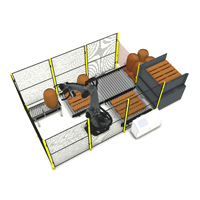 Barrel Palletiser
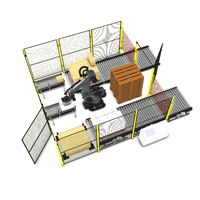 Box Palletiser
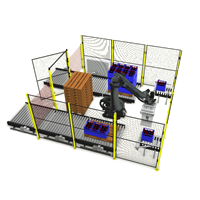 Crate Palletiser
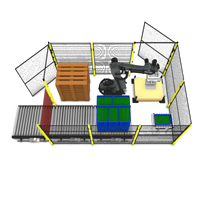 Tray Palletiser