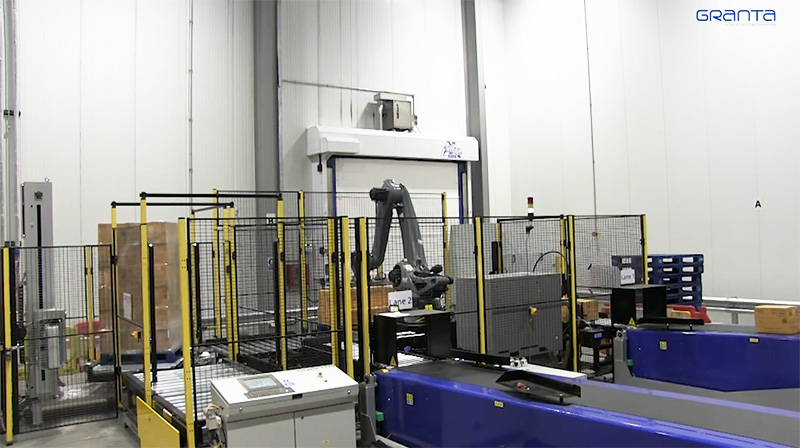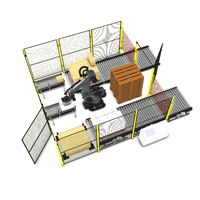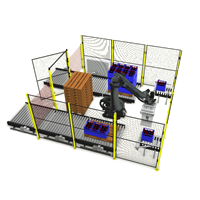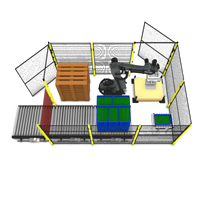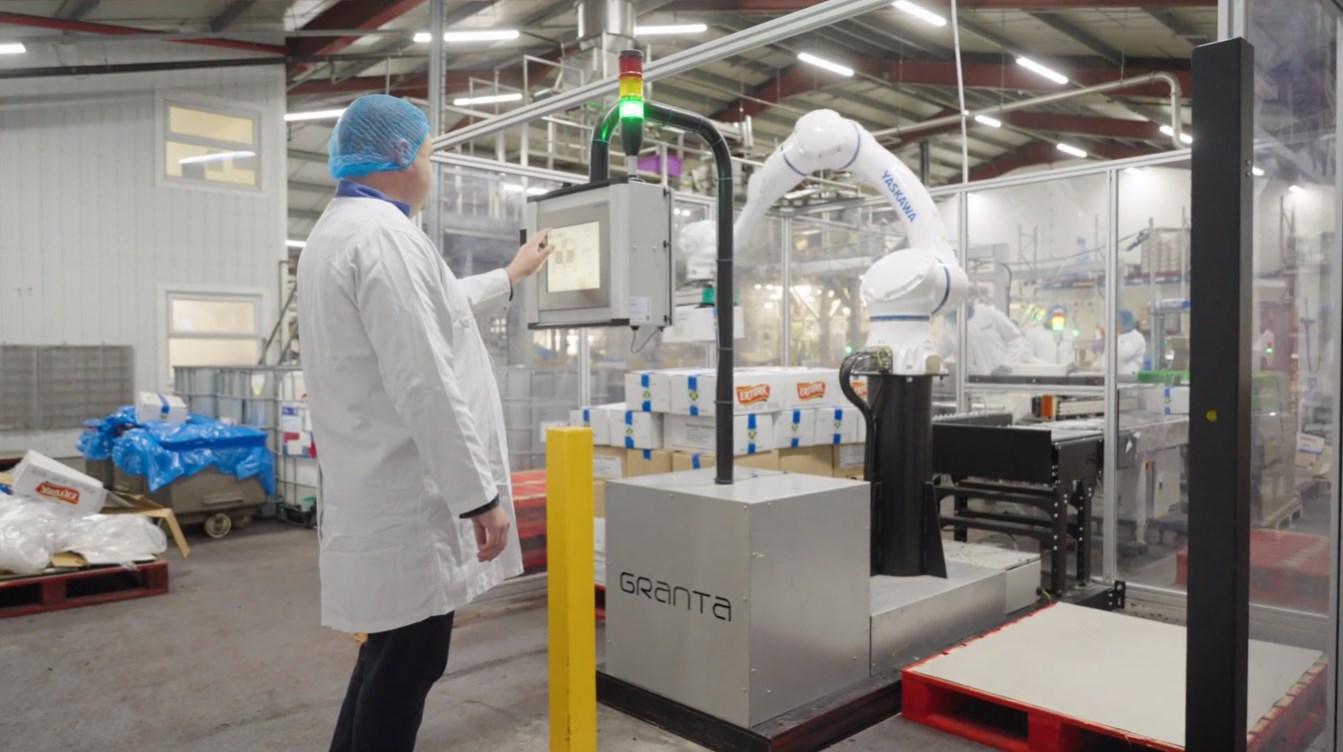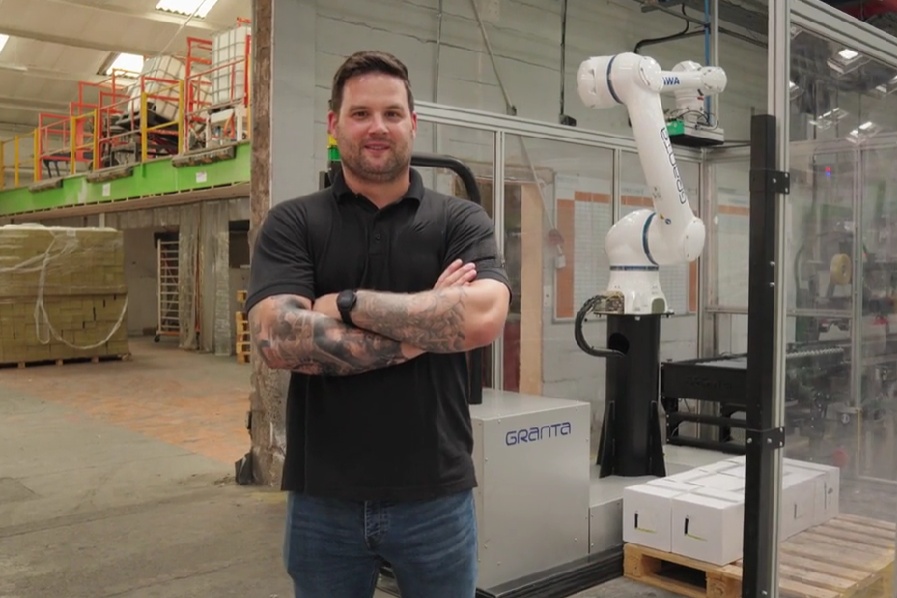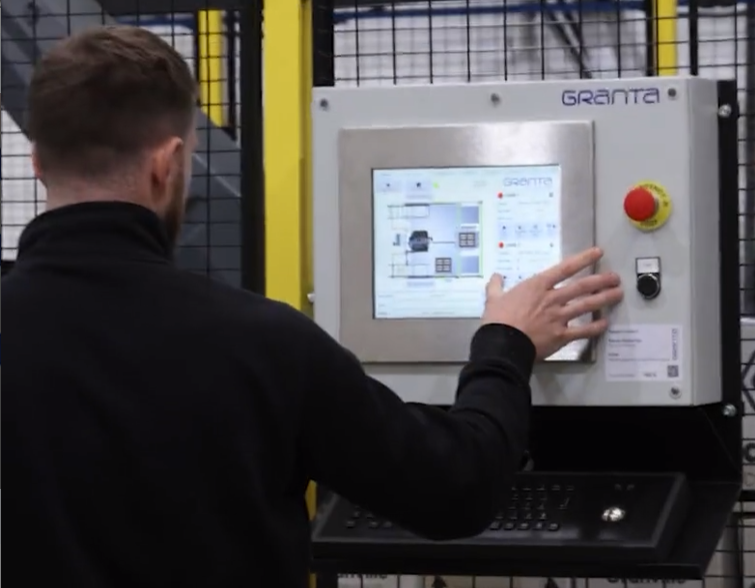
How long does it take to install a palletiser? For our customers, the answer was less than 48 hours from uncrating to stacking the first case on a pallet — not the 2+ weeks of downtime they were quoted elsewhere.
In this short video, real customers share their experience of a Granta installation — from arrival on site to full automation.
Most companies dread automation installs because of the production downtime. But it doesn’t have to be that way. Here’s what the video covers.
Installed by the end of day one
One customer was quoted a minimum of two weeks’ installation time elsewhere, with multiple engineers on site. Our team had their system installed by the end of the first day. A big reason for that speed is our patented modular palletiser design — the system arrives largely pre-built and pre-tested, so time on your factory floor is kept to a minimum.
Picking its first case in under 48 hours
From the moment the system arrived and was uncrated, to the moment it picked its first case and stacked it on a pallet, took less than 48 hours. That’s what installation should look like: measured in days, not weeks.
Three days of hands-on, on-site training
A fast install means nothing if your team can’t run the machine confidently. At one customer’s site in Whitton, our engineers stayed for three days of hands-on training, helping both the engineering and production teams set up and fully automate the machine.
Staying on to iron out integration issues
Our team then stayed a further day to supervise live operation — and resolved communication issues between the palletiser and other parts of the production line’s control system before leaving site. Integration problems are dealt with there and then, not left for you to discover on Monday morning.
Immediate post-installation support
When questions came up after the install, the response was immediate. As one customer put it, our engineers came out, sorted any problems quickly, and trained their staff thoroughly on every feature they asked for.
What installation should look like
Fast installation, thorough operator training, and responsive after-sales support — so your team actually succeeds with the machine. If you’re a manufacturer or production manager looking at case palletising, bag palletising or end-of-line automation with minimal downtime, this is how it should be done.
Want to know how quickly a palletiser could be up and running in your factory?
Palletiser downtime is rarely a crisis — product can usually be palletised manually in the short term, and where upstream production is sensitive to stoppages we often design in a dedicated offtake lane. But workarounds are still workarounds, and getting you back to full automation quickly matters. That’s why, at Granta, support isn’t an afterthought bolted onto the sale — it’s designed into everything we do, from the way we build our systems to the way we answer the phone.
Here’s how we keep palletisers running in some of the busiest factories in the UK and Ireland.
Support from the team that built your system
Our service and support is in-house and UK-based. When you call us, you’re not speaking to an overseas call centre or a third-party contractor — you’re speaking to the same team that designed, built and commissioned your system. They know your line, your product and your layout, which means faster diagnosis and fewer wasted visits.
We’re based in Linton, Cambridge, with our own design, build and assembly facilities, and we install and support systems nationwide across the UK and Ireland with our own team of remote engineers.
Remote support that resolves issues in minutes, not days
Every Granta system can be connected via ethernet or Wi-Fi, allowing our engineers to log in remotely, see exactly what the system is seeing, and in many cases diagnose and resolve the issue there and then. For a busy factory, that’s often the difference between a few minutes of downtime and waiting for an engineer to travel to site.
Where a site visit is needed, remote diagnosis means our engineer arrives knowing what the problem is — and with the right parts on the van.
A support contract built around your operation
Our standard support package includes three service visits per year, plus on-site and remote support. For operations running around the clock, cover can be extended right up to 24/7 — because we know that for many of our customers, night shift matters just as much as day shift.
During service visits our engineers check, adjust and maintain the system to keep it running at its best, helping you catch small issues before they become stoppages.
Spares, obsolescence and long-term supportability
A palletiser is a long-term investment, so we build for the long term. Our systems use current, long-life KUKA and Yaskawa robots, PLCs and HMIs with extended manufacturer support — and as a KUKA Platinum partner and Yaskawa partner, we have direct access to the people who make them.
We supply spare parts, provide a suggested spares list for your system, and can even integrate with your own stock system where that’s useful. We’ll also advise on lifecycle and recommended spares, so your system stays fully supportable for years to come.
Systems designed to be easy to run — and easy to fix
The best support call is the one you never need to make. Our patented easy-programming software means your own operators set up new stack patterns in around five minutes, with no robot skills required — so a product change never leaves you waiting for a specialist programmer.
Training that puts your team in control
Support starts on day one. Training is included as part of every installation, covering both operations and engineering staff — classroom sessions on safety, programs and fault conditions, followed by practical training on your actual system, with a knowledge test and certificates issued.
For engineering teams who want to go further, optional advanced training covers advanced programming, hardware, detailed fault diagnostics and routine maintenance checks. The more capable your team is, the less downtime you’ll ever see.
Data that helps you improve, not just recover
Our systems can log production and downtime data and generate reports, helping you track OEE and continuously improve the line. Good support isn’t just about fixing problems — it’s about giving you the information to prevent them.
Talk to us
Whether you’re running one of our systems or planning your first palletising project, we’re happy to help.
An end-of-line bottleneck is the stage of your packing, palletising, wrapping, or despatch process that limits the output of your entire production line. However fast the rest of your line runs, it can only ever produce at the rate of its slowest stage — which is why finding that stage is one of the most valuable exercises any manufacturer can carry out.
Most production lines are carefully measured and monitored at the front end. Filling speeds, packing rates, and machine performance are all tracked closely. Yet it is very often the end of the line — where products are boxed, palletised, wrapped, and moved away — where output quietly slips. Because this part of the process is frequently more manual and less instrumented than the rest of the line, a production line bottleneck here can go unnoticed for a long time, and its cost can be far greater than it first appears.
The good news is that end-of-line bottlenecks are usually straightforward to find once you know what to look for. Below, we walk through the practical steps we recommend to any manufacturer who suspects their line is capable of more than it is currently delivering.
The Common Signs of an End-of-Line Bottleneck
Before any measurement, there are some telltale signs that your end-of-line packaging process is holding your line back. The most common signs of an end-of-line bottleneck are:
Product or boxes regularly accumulating ahead of one particular station
Upstream machines frequently stopping because the line behind them is “blocked”
Downstream equipment or operators intermittently standing idle, waiting for work
Output falling away in the second half of a shift as manual handling fatigue sets in
The line coping at average demand but struggling at peak or on your fastest products
If one or more of these sounds familiar, the following steps will help you pinpoint exactly where the constraint lies.
Start by Walking the Line
It sounds simple, but the single most valuable first step is to stand at the end of your line and watch it run for a full shift, or as much of one as you can. Not for five minutes — bottlenecks often hide during short observations and only reveal themselves over time.
As you watch, ask yourself a few questions. Where is product accumulating? Where are operators waiting? Where is equipment sitting idle? A build-up of boxes ahead of a workstation, or an operator standing empty-handed downstream of one, are both telling you the same thing: the constraint is somewhere in between.
Look for the Queue and the Gap
Every bottleneck produces two signatures. Immediately upstream of it, you will see a queue – product backing up, conveyors running full, or totes and boxes stacking on the floor. Immediately downstream, you will see a gap – equipment or people intermittently starved of work.
If boxes are accumulating before your palletising station while the stretch wrapper beyond it stands idle, the palletising step is your constraint. If pallets are queuing for the wrapper instead, the constraint has moved. Finding the point where “full” turns to “empty” is the quickest way to locate a bottleneck without any measurement equipment at all.
Measure the Rate at Each Stage
Observation will point you in the right direction, but numbers will confirm it. Take each stage of your end-of-line process in turn — case packing, check weighing, labelling, palletising, wrapping, and despatch — and measure the actual sustained rate of each, in units per hour, across a realistic period.
The word sustained matters here. A stage that runs quickly for ten minutes and then stops for five is not delivering its headline rate. What you are looking for is the true average output over a full shift, including all the stops, changeovers, and interruptions that happen in real production. Your bottleneck is simply the stage with the lowest sustained rate — and your whole line can only ever run as fast as that stage allows.
Don’t Overlook the Human Factors
At the end of the line, people are very often doing the heaviest and most repetitive work in the factory — lifting boxes, stacking pallets, and moving loads. This introduces a type of bottleneck that machinery does not suffer from: fatigue.
An operator hand-stacking pallets may comfortably match the line speed at 8am, but by mid-afternoon the rate naturally drops. Breaks, rotation, fatigue, absence, and the ongoing difficulty of recruiting for manual roles all affect end-of-line output in ways that a spot check will never reveal. If your line consistently produces less in the second half of a shift than the first, manual handling at the end of the line is a very likely cause.
Check Your Downtime Records
If you keep downtime logs, they are a rich source of evidence — but read them carefully. It is common for downtime to be recorded against the machine that stopped, rather than the machine that caused the stop. A filler that halts because the line behind it is backed up will appear in the log as filler downtime, when the real culprit may be a palletising station much further downstream.
Wherever you see repeated “blocked” or “waiting” entries, trace them back to their source. Bottlenecks at the end of the line have a habit of showing up as apparent problems everywhere else.
Watch What Happens at Peak
Many end-of-line processes cope perfectly well at average demand and fail at peak. If your bottleneck only appears during your busiest weeks, seasonal ramps, or when running your fastest products, it is no less real — it is simply intermittent. Make sure your observations and measurements include your most demanding production scenarios, not just a typical day, because it is at peak that a bottleneck costs you the most.
Beware of Moving the Problem
One final word of caution: bottlenecks move. Speed up your palletising and the constraint may shift to your stretch wrapper; automate your wrapping and it may shift to how quickly finished pallets are moved to storage. This is entirely normal, and it is why we always encourage customers to look at their end-of-line process as a whole system rather than a series of isolated stations. The goal is a balanced line, where every stage — including the transport of finished pallets away from it — can comfortably sustain the rate the line demands.
How to Fix an End-of-Line Bottleneck
In our experience, the end-of-line bottleneck most commonly turns out to be palletising — either a manual operation that cannot sustain the line rate across a full shift, or an older machine that stacks quickly on paper but stops frequently in practice. The second most common is pallet logistics: full pallets not being moved away fast enough, so the palletiser itself ends up blocked.
Both are very solvable. The most effective way to remove an end-of-line bottleneck is to automate the constraining stage — most often with a robotic palletising system that can sustain the line rate hour after hour without fade, supported by AMRs that keep finished pallets flowing away from the line automatically. Just as importantly, a well-specified system is designed to a realistic, agreed throughput target — with headroom for real-world variation — and proven against that target before it ever reaches your factory floor.
Talk to Us
If you suspect there is a palletising bottleneck in your end-of-line process, or you have found one and would like help removing it, we would be very happy to talk it through with you. We can help you assess your current line, identify where the constraint really lies, and recommend the right solution — whether that is a cobot, compact, modular or prebuilt palletiser, AMRs to move your pallets, or a combination.
Do get in touch with the Granta team on 01223 499488 or email helpline@granta-automation.co.uk, and achieve with automation.
Get in touch with our team on 01223 499488 or email helpline@granta-automation.co.uk, and achieve with automation.
Stop and think about your day so far. The breakfast you ate. The drink you poured. The bits and pieces you picked up without a second thought. There’s a very good chance that several of them spent a moment of their journey to you on the arm of a Granta robotic palletiser.
Most of our customers aren’t household names – they’re the manufacturers, packers and distributors working quietly behind the scenes of British life. We keep their names confidential, but their products are everywhere. So here’s a tour of an ordinary day, and the everyday things a Granta palletiser very likely helped stack and get to you.
It probably started at breakfast
The gluten-free oats or the oat drink in your bowl. The cereal or the snack bar grabbed on the way out of the door. The eggs in the pan and the bread on the board – and the flour they were baked from. The jam or preserve on your toast, or the spreadable cheese on your bagel. The dried fruit, nuts and seeds sprinkled on top, and the herbal or fruit tea in your mug. Products just like these are palletised, every day, by Granta systems.
Open the cupboard and it carries on
The biscuits in the tin and the crisps in the lunchbox. The gravy granules and the batter mix. The cooking sauces, dessert mixes and bakery ingredients. The frozen rice and pasta, the oven chips and potato products in the freezer. The prepared salads and fresh foods in the fridge. The sea salt you season with, the chocolate you treat yourself to, and the countless food ingredients behind the meals you cook from scratch. Different shapes, sizes and weights – all handled by the same kind of Granta palletiser.
Fancy a drink?
The fruit juices and soft drinks in the fridge. The bottled water. The gin or spirits in your G&T – and the ice cubes chilling it. Even the glass bottles themselves. All the kinds of products our customers make, and our palletisers stack, day in, day out.
It isn’t just food and drink
Look around the house and garage. The household cleaning products under the sink. The adhesives, glues and sealants in the DIY drawer. The candle or home fragrance on the windowsill. Out in the garage, the car-care products, engine oils and lubricants – and the AdBlue for the diesel. Everyday essentials, quietly palletised before they ever reached you.
Step outside and it follows you
The fire-protection sealants and materials helping keep the building you’re in safe. The refractory materials that line industrial furnaces. The road markings guiding your commute. The construction fixings and building products holding things together. These are heavy, awkward, industrial products – exactly the sort that most need the manual lifting designed out of them, which is where a robotic palletiser earns its keep.
Even your pets and your garden birds
The food in your pet’s bowl. The feed for the animals. The seed in the garden bird feeder. Bagged, stacked and ready to ship by Granta systems too.
And everything you never see
Behind the scenes there’s more still: the pharmaceutical and medical products made under careful, controlled conditions; the printed cartons and packaging wrapped around so much of what you buy; agricultural chemicals; technical fibres. And right at the start of the chain, whole shipping containers of imported goods, unloaded and palletised automatically before they ever reach a shelf.
The remarkable part: one approach behind all of it
Cheese and chips, gin and glue, bird seed and fire sealant, oat milk and engine oil – wildly different products, weights, speeds and factories. And behind them, the same Granta approach: patented easy-programming palletising software your own team can run in minutes, a patented modular design, and industrial-grade KUKA and Yaskawa robots – all designed, built, installed and supported in-house in the UK.
Whether you make something the whole country would recognise or something the whole country uses without ever knowing your name, the numbers work the same way. Try our palletiser savings estimator to calculate your predicted payback, watch our systems in action, or book a free site visit and we’ll assess your requirements and recommend the right solution.
So next time you butter your toast, pour yourself a drink, top up the bird feeder or top up the AdBlue – there’s a fair chance a Granta palletiser helped get it to you.
Ask any production manager what keeps them awake at night, and sooner or later the conversation comes back to one number: throughput. How many units off the line per shift, per hour, per minute? It’s the figure that gets reported upwards, the one that determines whether an order ships on time, and the one that quietly decides whether a piece of automation was worth the investment.
So, when we talk about what we promise our customers, we don’t start with the kit. We start with that number. At Granta Automation, our approach is simple: we help our customers achieve with automation. That means delivering solutions that don’t just look good on paper, but consistently perform where it matters most – on your production line.
You’ve spent time and money getting product moving down the line at the rate you need. The last thing that should hold you up is the bit at the very end — stacking finished boxes onto a pallet. Yet end-of-line is exactly where a lot of production lines quietly lose pace, whether that’s a palletiser that can’t quite keep up with the box rate, or operators’ hand-stacking and tiring out as the shift goes on.
The palletiser shouldn’t be where your line slows down
A palletiser only earns its keep if it comfortably matches — and ideally outpaces — the rate boxes come off your line. That’s the standard we hold ourselves to. We’d rather supply a machine that keeps up every day, shift after shift, than one that looks fast on paper and then becomes the new bottleneck. Because for us, achieving with automation means making sure your investment delivers the throughput your business depends on.
Real throughput means sustained, reliable stacking
It’s easy to be impressed by a quoted cycle time. But a palletiser that handles a box quickly and then stops every twenty minutes for a misfeed or a toppled stack hasn’t solved anything. Real throughput is about steady, dependable output across a full shift.
That’s why we care as much about reliability as raw speed. Boxes vary — in size, weight, fill, and how square they sit. A machine that only performs when conditions are perfect isn’t much use on a busy production floor. We design and specify for the boxes you actually run, not the idealised ones, so the stack stays consistent and the line keeps moving.
We start by understanding your line, not selling you a machine
Before we recommend anything, we want to understand what’s coming off your line and how fast: your box dimensions and weights, the rate per minute, the pallet patterns you need, and how much that’s likely to change as your products do. We want to know where you are today and where you’re heading, so the palletiser we propose still fits in a couple of years’ time.
This matters because the right answer depends entirely on your numbers. A robust, achievable throughput target — agreed up front — is the difference between a palletiser that delivers and one that frustrates. It’s also how we make sure you achieve with automation from day one.
We design to your target
Once we agree on the rate you need to hit, that target shapes every decision: how the palletiser is configured, how product is fed and oriented into it, the pallet patterns, and the headroom we build in for real-world variation. We factor in the things that quietly erode output — product variation, planned and unplanned stops, changeovers between pallet patterns, and the gap between a machine’s theoretical speed and its actual availability.
Designing for genuine, sustained output rather than headline cycle time is what makes a throughput figure stick once the novelty wears off. It’s also how we ensure our customers continue to achieve with automation long after the machine has been commissioned.
We prove it before it leaves us
We don’t ask you to take our word for it. Wherever practical, we run factory acceptance testing so you can see the palletiser performing against the agreed numbers — with representative product — before it ever arrives on site. Then we validate it again during commissioning, on your floor, with your boxes, at your line speed.
That two-stage approach — prove it here, prove it there — means surprises get caught early, when they’re cheap to fix, rather than during a production ramp when they’re not.
And we stick around afterwards
A throughput figure isn’t something you hit once on day one and forget. Lines change, products change, and small issues compound if no one’s watching. Our commitment doesn’t end at sign-off. Through support, servicing, and a genuinely available phone line, we help you keep the palletiser doing its job for the long haul.
Because helping you achieve with automation isn’t just about installation day. It’s about making sure your investment continues delivering the performance you expected for years to come.
If something does go wrong, we want to be the people you call who actually pick up — not a name on an out-of-date contract.
A straightforward promise
We don’t think any of this should be remarkable. Helping you stack pallets fast enough to keep your line flowing is, quite simply, the job. But it’s surprising how often automation is sold on specifications rather than outcomes, and we’d rather be judged on the latter.
So that’s our commitment: we’ll be honest about what’s achievable, size the palletiser around the throughput that matters to you, prove it before and after installation, and stand behind it once it’s running. That’s what Achieve with Automation means at Granta Automation. It’s not just our strapline; it’s the promise that every automation solution we deliver is designed to help your business succeed.
If you’ve got a line that’s outpacing your end-of-line — or you’re still hand-stacking and feeling it — we’d be glad to have that conversation.
Get in touch with our team to talk through your line speed and the right palletising solution for it on 01223 499488 or email helpline@granta-automation.co.uk. You can also use our Palletiser Savings Estimator to get an indication of the return you could expect.
A single robotic palletiser can handle product from multiple production lines – and equally, there is nothing wrong with giving every line its own robot. Both approaches work, both are proven, and we design and build both. The right choice comes down to three things: speed, space, and access.
When we visit customer sites, one of the most common things we hear is surprise that a robot palletiser can take more than one input at all. Many people assume it is one robot, one line, full stop. In reality, there are several well-established ways to feed multiple lines into one robot. Here they are – along with an honest look at when each one makes sense.
The Configurations Most People Don’t Realise Exist
Multiple infeed conveyors into one robot. A robot cell with an infeed conveyor from each line, and pallet positions or pallet conveyors as outputs. A typical layout has the robot in the centre with one or two conveyors on each side. One thing to be aware of: robot reach sets a physical limit. As a rule of thumb, a static robot can serve up to six – at most seven – pallet positions plus an infeed. You certainly couldn’t pick off eight infeed conveyors and place onto eight pallets; the robot simply wouldn’t reach. Beyond that point, you need a track system.
One collated infeed, many products. You don’t necessarily need a conveyor per line. Several lines can be merged onto a single infeed conveyor, with a barcode reader at the end identifying each product as it arrives. The robot then stacks each item – trays, boxes, bags, shrink-wrapped packs – onto its correct pallet. We have systems in the field built exactly this way: one infeed feeding a robot surrounded by a ring of six pallets, with every product automatically placed on the right stack.
Track-mounted robots for large pallet counts. A static robot runs out of reach at around six or seven pallet positions. Need more than that? You have two options: add extra palletisers, or – if the rates are slow enough – mount one robot on a sliding track. A track-mounted robot typically serves from around seven pallet positions upwards: that could be seven, twenty, thirty or more, with no real limit other than floor space, because the track can simply be made longer.
How the Options Compare
System style
Speed
Space
Things to consider
One robot per line
Fastest per line. With row gripping and auto-rotation, a dedicated robot can keep up with lines running at 30–50 products a minute.
A cell at the end of every line. Access between lines stays open.
Highest total cost if you have many lines – but maximum flexibility and redundancy. If one cell stops, the other lines keep running.
One robot, multiple infeed conveyors
Good. Each conveyor carries one product type in sequence, so the robot can row pick – placing several products per move. The robot’s total capacity is shared across the lines.
One cell instead of several. Each line needs its own conveyor into the cell, plus buffering space for products to accumulate while the robot serves the other lanes.
Robot reach is the limit – a static robot can serve around six or seven pallet positions plus an infeed at most. Connecting conveyors can block access between lines.
One robot, single collated infeed (barcode sorting)
Slower. Mixed products arrive in random order, so row picking isn’t possible – every pick is one at a time, and that caps the speed.
Very compact at the robot – e.g. a ring of six pallets around one cell, with only one conveyor into it. The merging of lines happens upstream.
Best suited to lower-rate lines. A barcode reader at the end of the infeed identifies each product so it lands on the correct pallet. The merging conveyors can block access between lines – and a fault on the shared infeed (a broken belt, say) stops every line feeding it.
Track-mounted robot
Slowest. Every pick is individual, plus travel time along the track between pallets.
Takes over where a static robot runs out of reach – typically from around seven pallet positions upwards. That could be 7, 20, 30 or more; the only limit is floor space for the track.
Ideal for slow sorting applications, such as dispatch areas where mixed products need distributing across many pallets.
Speed: The Biggest Deciding Factor
Speed decides more than anything else. A single line running at thirty, forty or fifty products a minute can max out a robot entirely on its own – that line needs its own dedicated palletiser. At the other extreme, one robot can comfortably serve many slow lines; as a rough guide, around eight lines each running at a bag a minute is well within reach.
How products arrive matters just as much as how fast. Wherever the same product arrives in sequence – on a dedicated line, or in a multi-infeed cell where each conveyor carries one product type – the robot can row grip: picking a whole row of identical products in one move. This is where our patented easy programming software gives Granta systems a genuine edge; it is the only software able to automatically group picks into rows, with auto-rotation, multiplying throughput because every robot move places several products.
But here is the catch with a collated infeed: when products from different lines arrive one by one and mixed together, row gripping is not normally possible – rows need the same product in order. A mixed infeed effectively fixes your speed at one pick at a time. In theory you can add buffering before the lines merge and release products in batches ready for row picking, but this is very technical, often challenging, and rarely practical. If lines are merged onto one conveyor, plan around individual picks.
Space and Access: The Practical Realities
Space can point you either way. A single robot with six pallet positions, or even a big track-mounted system, can be far more compact than the equivalent done manually or with a machine per line – or it can occupy more space. It depends entirely on your current layout, which is why we always start by looking at the site itself.
Access is the factor people most often overlook. Joining several line ends together with conveyors physically blocks the routes between your production lines. If operators need to walk between lines – to reach a box erector, for example – a run of connecting conveyors is in the way. There are good solutions: drawbridge-style conveyors that lift for access, step-over platforms where only personnel access is needed, or high-level conveyors – such as a spiral up and over the walkway. But all of these need designing in from the start.
Finally, resilience. With a shared system, all the connected lines depend on the same equipment – if a belt breaks on a shared infeed conveyor, every line feeding that cell stops until it’s fixed. With a robot per line, only the affected line stops.
So Which Should You Choose?
Fast lines deserve their own robots. Slow lines can share one – and save a lot of money and floor space doing it. If you need to sort onto a large number of pallets, a track-mounted robot will do it at a gentler pace. And in every case, check the practicalities early: robot reach, buffering space, and how operators will move around the cell.
We genuinely don’t mind which way you go – we design, build and support all of these configurations, and our job is to recommend the one that fits your products, speeds and layout.
If you’d like to talk through which configuration would suit your operation, get in touch with us on 01223 499488 or email helpline@granta-automation.co.uk. You can also use our Palletiser Savings Estimator to get an indication of the return you could expect.
It is one of the first questions we are asked when a customer starts thinking about Autonomous Mobile Robots, and it is a very sensible place to begin. After all, the number of AMRs you deploy has a direct bearing on both the performance of your operation and the cost of your project.
The honest answer is that there is no single number that fits every facility. The right fleet size depends on how much you need to move, how far it has to travel, and how quickly it all needs to happen. The good news is that working it out is far more straightforward than it might first appear. Below, we walk through the main factors that determine how many AMRs you require, and how we help you arrive at the right figure.
Start With the Work, Not the Robot
Before counting robots, it helps to be clear about the job they are doing. In most of our applications, AMRs are moving pallets — typically taking full pallets away from a palletising system to a storage area, and often returning empty pallets back into the system.
The key number here is your throughput: how many pallets (or loads) need to be moved in a given period, usually expressed per hour. A line producing 30 full pallets an hour places very different demands on a fleet than one producing 80. Establishing this figure first gives us a solid foundation for everything that follows.
How Long Does One Full Cycle Take?
The next thing to understand is the cycle time of a single AMR — the time it takes to complete one full job and be ready for the next. A typical cycle includes:
Travelling to the pickup point
Loading the pallet
Travelling to the drop-off point
Offloading the pallet
Returning, ready for the next task
Add these together and you have the time for one round trip. If for example a single cycle takes around five minutes, one AMR can complete roughly twelve moves an hour in ideal conditions. Compare that figure against your required throughput and the rough shape of your fleet begins to emerge.
What About Charging?
A common worry is that charging will eat into the working day, but in practice it rarely causes a headache. AMRs and AGVs charge themselves automatically: whenever there is no works order waiting, the robot simply takes itself off to a charging station and tops up, then returns to work the moment it is needed again. The charging happens in the quiet spells, not in the middle of a job.
For a standard single shift — a normal eight-hour day — many operations manage perfectly well without any dedicated charging time at all, unless usage is exceptionally heavy. It is really only as you move towards continuous, 24/7 running that charging starts to take a meaningful slice out of available time.
Plan for Your Peaks, Not Just Your Average
Many operations have a steady average demand but experience busier spells — a shift changeover, a surge of orders, or simply the natural rhythm of a production day. If you size your fleet purely around the average, those peaks can create bottlenecks.
We always recommend looking at your busiest realistic period and making sure the fleet can comfortably cope. Adding one robot of headroom for peaks and redundancy is often a worthwhile investment; it means that if demand spikes, or if one AMR is taken out for maintenance, your operation keeps flowing.
Consider Layout, Distance and Traffic
The physical layout of your facility matters a great deal. Longer travel distances increase cycle times, which in turn increases the number of robots needed to hit the same throughput. The number of pickup and drop-off points, the width of aisles, and how much other traffic shares the space all play their part too.
This is where intelligent fleet software earns its keep. Our AMRs are managed by the GoControl system, which receives, prioritises and dispatches jobs automatically, routing each robot efficiently and re-planning around obstacles. Well-managed traffic means each AMR spends more of its time working and less of it waiting — which can reduce the number of robots you ultimately need.
Think About Tomorrow as Well as Today
It is always worth asking where your operation is heading. One of the great advantages of AMRs is their scalability — you are not locked into a fixed installation. If your volumes grow, you can add robots to the existing fleet, and the software will simply incorporate them.
For that reason, many of our customers choose to start with the fleet that meets today’s needs while keeping a clear plan for expansion. You get the benefits now without over-investing, and a straightforward route to grow when the time is right.
A Simple Way to Estimate
There are two ways we tend to approach this — a quick rule of thumb, and a more detailed calculation.
The quick rule of thumb
A conservative starting point is to look at how the work is done today. As a rough guide, for every forklift operator currently moving your pallets, you will need approximately 1 to 1.5 AMRs or AGVs. It is not exact, but it gives you a sensible ballpark in seconds.
The more detailed method
For a closer estimate, we work through the cycle in a little more detail:
Allow a travel speed of around 1 metre per second, and measure the distances the robot will cover on a typical job.
Add one minute for each pallet pick-up and one minute for each drop-down.
Multiply the resulting capacity by 0.85, to allow 15 per cent for charging time.
Finally, apply a route congestion factor to account for traffic and shared space, using the table below.
Route Congestion Factor
Description
1.00
Wide lanes, more than 3m per AMR/AGV, with no other congestion
0.80
Wide lanes, more than 3m per AMR/AGV, but shared with people / forklifts
0.95
Narrow lanes, 2–3m wide per AMR/AGV, with no other congestion
0.70
Narrow lanes, 2–3m wide per AMR/AGV, but shared with people / forklifts
0.10
Very narrow lanes, less than 2m (and no less than 1.6m)
Where lanes are not wide enough for two AMRs/AGVs to pass, also add a waiting time factor to allow for passing places — for example, 0.90 if you estimate the robot will be waiting around 10 per cent of the time.
This gives a realistic view of how many moves each robot can achieve in an hour, and therefore how many robots you need to meet your throughput.
It is a helpful guide, but every facility is different, and small changes in layout or process can shift the answer. That is why we never rely on a rule of thumb alone for a final specification.
The Best Answer Comes From Working It Out Together
Sizing an AMR fleet well is part calculation and part experience. By understanding your throughput, your layout and your goals, we can model the right number of robots for your operation — enough to keep things moving smoothly, without paying for capacity you do not need.
If you would like help working out how many AMRs your operation requires, we would be very happy to talk it through and put together an estimate tailored to your facility. Please do get in touch on 01223 499488or email us at helpline@granta-automation.co.uk. We will be very happy to help.
If you manage a bustling UK warehousing or manufacturing site, you know that keeping up with shifting consumer demands is harder than ever. You might look at the competition and wonder how they manage to despatch orders at lightning speeds, scale up smoothly during peak times, and protect their margins against soaring operational pressures.
The reality is that your competitors aren’t necessarily working harder—they have identified and closed structural efficiency gaps that drag down traditional operations. In British logistics, productivity is often won or lost at the end-of-line and intralogistics workflows.
Below are three specific productivity gaps that may be holding unautomated operations back, alongside the actionable steps needed to close them.
1. The Human Velocity Cap: Manual Palletising Bottlenecks
A common misconception in warehousing is that throughput is determined by the speed of your processing or picking lines. However, a major hidden drain on your bottom line is the packing and palletising hall.
When product stacks up at the end of the line, your entire operation has to slow down to prevent a backlog. Relying on manual labour to stack boxes, containers, or heavy sacks creates a “Human Velocity Cap”:
The Fatigue Curve: A human operator might start a shift performing at peak speed, but fatigue inevitably sets in. By hour six or seven, manual handling slows down, creating an unpredictable operational flow.
The High Churn Cycle: Manual palletising is repetitive and physically gruelling. Warehouses face heavy costs from constant staff turnover in low-skilled packing departments, resulting in endless recruitment and agency fees.
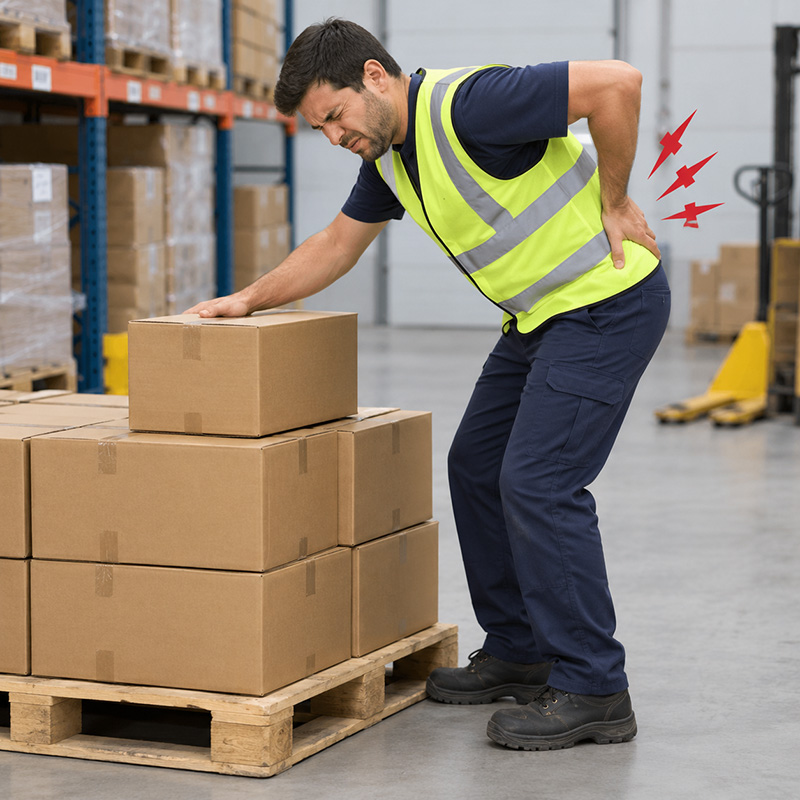
Health and Safety Liability: Repetitive strain and back injuries from lifting heavy boxes are an ongoing risk. A single health and safety claim can damage your team’s morale and drain unexpected capital.
Closing the Gap
Transitioning to an industrial robotic palletising system or a cobot palletiser replaces physical strain with continuous, predictable operation. Industrial robots don’t require breaks, don’t call in sick, and maintain a consistent speed 24 hours a day, 7 days a week. This forced takt time normally yields an immediate production increase of around 40%.
2. The Dead-Time Drain: Manual Intralogistics and Forklift Congestion
How much time do your warehouse associates spend simply walking across the floor, waiting on instructions, or moving empty pallets? In many traditional UK layouts, materials travel much further than necessary.
Relying entirely on manual forklifts or pallet trucks to ferry goods between the end-of-line packaging bay and the despatch docks introduces major inefficiencies:
Traffic & Congestion: Busy shift hours create bottlenecks in high-traffic aisles. If one forklift is delayed, downstream stations are left waiting on empty inputs.
Underutilised Skilled Labour: When an employee spends half their shift acting as a basic transport mechanism, you are paying skilled wages for low-value travel time.
Transport Method
Flexibility
Safety Profile
Speed & Routing
Manual Forklift
High, but limited by operator availability
Risk of collision in narrow or busy aisles
Prone to human delays and congestion
Fixed Conveyors
Low; requires permanent floor-space
High safety, but creates physical layout barriers
Constant speed, but completely rigid
Autonomous Mobile Robots (AMRs)
Medium/High; maps can be edited in minutes or AMRs can automatically recalculate routes instantly
360° laser sensors and 3D cameras for human safety
Smart navigation; automatically reroutes around obstacles
Closing the Gap
Deploying a fleet of Autonomous Mobile Robots (AMRs) or Automated Guided Vehicles (AGVs) bridges the distance gap. Rather than overhauling your physical infrastructure with rigid, fixed conveyor lines, intelligent AMRs can seamlessly integrate into your current layout. They handle the heavy lifting and cross-floor transport automatically, allowing your human staff to focus on high-priority, value-added tasks.
3. The Flexibility Friction: Rigid Equipment vs. Rising SKU Counts
With rising SKU counts and tighter production schedules, modern warehouses must be highly agile. If it takes your team 30 minutes to manually reconfigure a packing line or reprogram an old mechanical stacker for a new box size, you are losing valuable throughput to planned downtime.
A rigid end-of-line system forces you into batch picking dependencies and downstream sorting areas that eat up valuable real estate.
Closing the Gap
Modern robotic palletisers feature advanced, intuitive software that enables operators to switch between product sizes or pallet stack patterns in less than 5 minutes without advanced technical training. The most sophisticated systems take this a step further with fully automated programming, where the palletiser automatically measures each incoming box and generates the optimal stacking program for the robot itself—eliminating manual setup entirely. High-performance systems can handle multi-infeed layouts—meaning a single robot cell can accept products from two or more distinct lines and simultaneously build different stack patterns on separate pallet positions.
Factoring in the “Cost of Inaction”
When evaluating automation, many finance directors look at a basic calculation: Cost of Machine ÷ Monthly Wages Saved.
To see the true Return on Investment (ROI), you must factor in the hidden operational drains: the price of product damage, agency premiums during seasonal peaks, missed growth opportunities due to labour caps, and the floor space saved by eliminating sorting zones. When these factors are calculated, the payback period for a modular palletising cell is often less than one year.
Closing these three productivity gaps isn’t about out-working the competition—it’s about de-risking your future with flexible, scalable infrastructure.
You may find the following tools useful in helping you to calculate the ROI of an automated palletising system.
Across the UK manufacturing sector, recruitment has become one of the more significant barriers to growth.
Whether producing food and drink products, pharmaceuticals, consumer goods or industrial components, many manufacturers are facing the same challenge: finding and retaining people for operational roles.
While labour shortages affect multiple areas of manufacturing, manual packing and end-of-line positions are often among the hardest jobs to fill. Vacancies remain open for longer, staff turnover can be high, and businesses are increasingly competing for a shrinking pool of candidates.
At the same time, a new generation is entering the workforce with different expectations, different priorities and more career options than ever before.
The result is a growing disconnect between the roles manufacturers need to fill and the types of jobs many young workers are actively seeking.
For businesses that rely heavily on manual packing operations, this presents a challenge that cannot be ignored.
A Changing Workforce
Every generation enters the workplace with different expectations, but today’s school leavers and younger workers have grown up in a fundamentally different environment.
Technology has become an integral part of everyday life. Digital skills are highly valued. Schools, colleges and careers advisers increasingly encourage students to pursue opportunities that offer development, progression and long-term career prospects.
Young people today are also exposed to a much wider range of employment opportunities than previous generations.
Alongside traditional manufacturing careers, they have access to:
Apprenticeships across a wide range of industries
Higher and further education pathways
Technology and digital careers
Service-sector opportunities
Flexible and hybrid working environments
Entrepreneurial ventures and self-employment
Against this backdrop, repetitive manual roles can struggle to compete for attention.
This doesn’t mean younger workers are unwilling to work hard, nor does it mean manufacturing has become unattractive. In fact, many young people are highly interested in engineering, robotics, automation and advanced manufacturing technologies.
The challenge is that they are often looking for careers that provide opportunities to learn, develop skills and progress over time.
Why Manual Packing Roles Are Becoming Harder to Fill
Packing remains an essential part of manufacturing and distribution operations.
Products still need to be packed, sorted, labelled, stacked and prepared for dispatch. However, many manual packing positions involve characteristics that can make recruitment increasingly difficult.
These roles often include:
Repetitive tasks performed throughout a shift
Physically demanding activities
Limited day-to-day variation
High-volume production targets
Shift-based working patterns
Fewer opportunities for technical skill development
For decades, businesses were generally able to recruit workers to perform these functions. Today, however, many manufacturers report that attracting younger candidates has become significantly more challenging.
When alternative employment opportunities offer greater flexibility, technology exposure or clearer progression pathways, manual packing roles can become a less attractive option.
As a result, recruitment pipelines are shrinking just as many manufacturers need additional capacity to support growth.
The Recruitment Challenge Goes Beyond Labour Shortages
It would be easy to blame the issue entirely on labour shortages, but the reality is more complex.
Manufacturers are facing a combination of long-term trends that are reshaping the workforce.
These include:
An Ageing Workforce Many experienced manufacturing employees are approaching retirement age, creating a growing need to replace skilled and semi-skilled workers.
Increased Competition for Talent Manufacturing businesses are no longer competing solely with other manufacturers. Warehousing, logistics, retail, construction and service industries are all drawing from the same labour pool.
Changing Career Expectations Many younger workers are seeking roles that provide learning opportunities, progression and personal development rather than simply offering stable employment.
Skills-Based Employment Markets Employers increasingly value technical and digital skills, while younger workers are increasingly focused on acquiring them.
Together, these factors are creating a recruitment environment that looks very different from the one manufacturers operated in even ten years ago.
The Hidden Cost of Unfilled Packing Roles
When businesses cannot recruit enough people for manual packing operations, the consequences quickly spread throughout the organisation.
Labour shortages often lead to:
Reduced Production Capacity Production output can become constrained by staffing levels rather than equipment capabilities.
Increased Overtime Costs Existing teams are frequently required to work additional hours to maintain output targets.
Higher Employee Fatigue Persistent staffing shortages can place additional pressure on employees, increasing the risk of burnout and absenteeism.
Recruitment and Training Costs The cycle of recruiting, onboarding and replacing staff can become expensive and time-consuming.
Inconsistent Performance Manual processes can become more difficult to manage consistently when teams are under pressure or operating below ideal staffing levels.
For many manufacturers, these costs accumulate quietly over time, reducing efficiency and limiting growth opportunities.
Why Automation Is Becoming a Strategic Necessity
Historically, automation projects were often justified primarily through labour savings.
Today, the conversation has changed.
Many manufacturers are investing in automation because they can no longer rely on a steady supply of labour for repetitive operational tasks.
The question is no longer:
“How many jobs can automation replace?”
Instead, businesses are asking:
“How can we continue growing when recruitment is becoming increasingly difficult?”
Automation provides a practical answer.
By automating repetitive packing and palletising tasks, manufacturers can reduce their dependence on roles that are becoming harder to recruit for while improving operational consistency.
The Benefits Extend Beyond Recruitment
While labour availability may be the catalyst for automation investment, the benefits often extend much further.
Modern automated packing systems can help manufacturers:
Increase throughput
Improve packing consistency
Reduce product handling errors
Improve traceability
Support workplace safety initiatives
Operate more predictably during labour shortages
Scale production more effectively
Unlike manual processes, automated systems deliver consistent performance regardless of labour market fluctuations.
This creates a more resilient operation capable of responding to changing customer demands.
Creating More Attractive Manufacturing Careers
One of the most overlooked benefits of automation is its ability to improve the quality of jobs available within a business.
When repetitive manual tasks are automated, employees can be redeployed into higher-value activities such as:
Machine operation
Quality assurance
Production planning
Process optimisation
Equipment maintenance
Continuous improvement initiatives
These responsibilities often align more closely with what younger workers are seeking from their careers.
Rather than spending entire shifts performing repetitive tasks, employees can develop technical skills that support long-term career progression.
For manufacturers looking to attract the next generation of talent, this can become a significant competitive advantage.
Future-Proofing Manufacturing Operations
The recruitment challenges facing UK manufacturing are unlikely to disappear overnight.
Demographic trends, changing workforce expectations and ongoing competition for labour suggest that businesses will need to adapt if they want to maintain productivity and growth.
The most successful manufacturers are increasingly recognising that automation and workforce development are not competing priorities; they are complementary strategies.
By automating repetitive tasks while investing in higher-skilled roles, businesses can create operations that are more productive, more resilient and more attractive to future employees.
As workforce expectations continue to evolve, automation is becoming more than a productivity improvement. It is an essential tool for building a manufacturing operation that is ready for the future.
When assessing whether to transition a production or warehouse line to automation, the decision usually centres on three core operational pillars: financial sustainability, workplace safety, and volume consistency.
A side-by-side evaluation reveals exactly how traditional manual stacking compares to automated robotic and collaborative robot palletising.
The Strategic Breakdown
Operational Vector
Manual Palletising
Automatic Palletising
Operational Cost
Low upfront capital, but highly variable ongoing costs. Tied directly to labour market fluctuations, agency premiums, and recruitment overhead.
High initial capital expenditure (CapEx), but extremely low, predictable ongoing operational expenditure (OpEx) for power and periodic maintenance.
Throughput & Speed
Highly variable. Strongly dependent on shift timing, box weights, and operator stamina. Subject to a steady decline in cycle times over an 8-hour shift.
Constant and deterministic. Runs at a fixed, programmable takt time (e.g., 12–30 picks per minute) without degradation over 24 hours.
Workplace Safety
High risk profile. Represents a leading cause of repetitive strain injuries (RSIs), musculoskeletal disorders (MSDs), and long-term worker fatigue.
Zero human injury risk from lifting. Equipment utilises safety fencing, light curtains, or proximity scanners to isolate or mitigate human hazards.
Footprint Flexibility
Highly adaptable footprint in the short term, but requires substantial, clear floor space for multiple human operators to move around safely with pallet jacks.
Highly compact, dedicated cell footprint. With easy programming software, can be easily reprogrammed for new layer patterns, box weights, or sizes via software in under 5 minutes.
1. Deep Dive: Operational Cost Structure
The financial contrast between manual and automatic setups is a balance of immediate flexibility versus long-term margin protection.
Manual Cost Realities
While manual stacking requires zero initial machinery investments, it exposes your cash flow to cumulative operational drains:
The Premium Factor: Relying on seasonal temp agencies to cover volume spikes means paying marked-up hourly rates, often while absorbing the cost of training workers who may only stay a few weeks.
The Friction of Churn: End-of-line stacking has one of the highest turnover rates in logistics. The hidden cost of constant recruitment, onboarding, and background checks heavily penalises profitability.
Automated Cost Realities
Automation shifts your expenditure from an unpredictable variable cost to a fixed asset. A standard industrial robotic cell typically draws minimal electricity and requires simple scheduled preventative maintenance annually.
The True ROI Math: When factoring in the elimination of product damage (from dropped cases), reduced shrink-wrap waste through uniform automatic application, and the reclamation of indirect management hours, most UK facilities find that an automated cell achieves complete payback within 12 to 18 months.
2. Deep Dive: Throughput and Volumetric Consistency
Manual throughput is governed by biological limits, whereas automated throughput is governed by mechanical parameters.
Manual Shift Throughput(Declines over time due to fatigue) ⏱️ Hour 1: 100% ── ⏱️ Hour 4: 85% ── ⏱️ Hour 8: 65%
A human operator handling 15kg cartons may start a shift comfortably moving 10 to 12 boxes per minute. However, after moving several tons of material, fatigue naturally sets in. By hour 6, that pace often drops by 30–40%, causing upstream processing bottlenecks.
Robotic grippers handle heavy payloads at the exact same velocity during consecutive shifts. This predictability allows supply chain managers to accurately forecast outbound dispatch schedules down to the exact hour, completely smoothing out the “bullwhip effect” inside the warehouse.
3. Deep Dive: Workplace Safety and Ergonomics
Under the UK’s Health and Safety Executive (HSE) guidelines, employers are strictly obligated to minimise the risks of manual handling. End-of-line stacking forces operators into repetitive lifting, twisting, and reaching movements—the exact combination that causes spinal compression and muscular strains.
Manual Risk: Beyond the human toll of injury, businesses bear the financial burden of sick leave, occupational health assessments, and increased insurance premiums.
Automated Safety: An industrial robot handles the heavy, repetitive lifting in an enclosed environment. Standard cells are protected by safety interlocks and light curtains; if a human opens a gate or crosses a beam, the system instantly cuts power to the arm.
For tighter spaces where fencing isn’t viable, Collaborative Robots (Cobots) utilise power and force limiting sensors. If a cobot detects the slightest contact with an operator, it safely stops mid-motion without causing injury, allowing humans and machines to work side-by-side.
Ultimately, the choice between manual and automated palletising isn’t just a question of upgrading machinery—it is a strategic decision about how you protect your margins and scale your operations. While manual handling will always play a role in short-term, highly unpredictable setups, it leaves your primary throughput vulnerable to labour market spikes, rising injury liabilities, and unavoidable fatigue curves.
By contrast, end-of-line automation transforms your logistics into a fixed, predictable, and highly scalable asset. In a landscape where speed and reliability dictate which businesses win and keep major retail contracts, investing in automated workflows is no longer just a luxury for the industry giants. It is the exact tool UK warehouses need to outpace the competition, secure their workforce, and guarantee long-term profitability.
You may find the following tools useful in helping you to calculate the ROI of an automated palletising system.
Granta Automation is the leading UK manufacturer of robotic palletisers, cobot palletisers, and compact and modular palletising systems, as well as automated container unloading, depalletising and cross-stacking systems, AGVs and AMRs. A top tier KUKA Platinum partner and Yaskawa partner with a huge number of installs and patented easy-programming palletising software and patented modular palletisers. Granta Automation design, build, install and support complete end-of-line palletising systems for manufacturers across the UK and Ireland. Established 2006.
Copyright 2026 Granta Automation Ltd. All rights reserved. Our palletising software and modular system are patented (GB2602358, EP3689539).